4 risultati per GMT
Riccardo Zingone 23/10/2026 0
Federico Massimo Ceschin and the Visitor Economy: A New Paradigm for Italy’s Inner Areas
Visitor Economy: beyond the numbers, towards a new paradigm for territorial development
Interview with Federico Massimo Ceschin, author of Visitor Economy, Volumes 1 and 2
For years, we have measured tourism’s success through arrivals, overnight stays and the growth of accommodation capacity. But are these indicators enough to describe the value tourism generates for a territory—and, above all, how much of that value remains in the host communities?
This question is the starting point for our conversation with Federico Massimo Ceschin, author of the two volumes of Visitor Economy (Movability, 2024 and 2026). He works to promote new models of territorial development and is president of SIMTUR, the professional ecosystem for regenerative tourism, of which I am a member.
His proposal forms part of the wider transformation of tourism from sustainability to regeneration. Sustainability seeks to reduce the negative impacts of tourism; regeneration aims to create tangible benefits for the environment, local economies and resident communities. The goal, therefore, is not simply to use fewer resources, but to help restore and enhance them.
This approach is also reflected in European policy through the European Agenda for Tourism 2030. In Italy, the Strategic Tourism Plan 2023–2027 incorporates several principles of sustainability and innovation. The question of how to apply them in practice—and, above all, how to measure the benefits they produce in local areas—remains open.
Ceschin’s two books, aimed at public administrators, tourism businesses, local development professionals and communities, offer a way of thinking that moves beyond the traditional focus on tourists and considers the full range of economic, social and cultural relationships generated by visitors.
This perspective is particularly relevant to the GMT™ Halaesa Nebrodi, whose work is rooted in the idea of a Culture of Hospitality, as developed by Andrea Succi, the creator of Territori e Italianità. Its values are repeatedly reflected in Ceschin’s work.
Reading the two volumes led us to the seven questions we put to Ceschin: a conversation about the meaning of the Visitor Economy, the role of communities, the limits of current measurement systems and the practical possibilities for changing the paradigm.
Riccardo Zingone — Territorial Tourism Coordinator (CTT™), GMT™ Halaesa Nebrodi
The Visitor Economy: a paradigm shift
Tourism is measured by what comes in: arrivals, overnight stays and turnover. The Visitor Economy is measured by what remains and is renewed. Value is what a territory retains and puts to work over time; a flow is only a receipt. A territory can set records for overnight stays—statistics will register this as success—while it loses residents, neighbourhood shops and even the people who care for its places and communities.
The paradigm shift has three steps. First, we look at everyone who passes through a place, including people who do not stay overnight. Second, we measure the value retained alongside visitor flows. Third, we give someone the responsibility for keeping the territory alive—a responsibility that no public body currently holds explicitly. Destination Management Organisations (DMOs) have a promotional mandate, municipalities have an administrative one, and regions allocate resources. This new perspective is intended for administrators, businesses and professionals who plan destinations, but above all for communities: without their recognition, no strategy can truly be effective.
From tourist to visitor: beyond definitions
International institutions define a visitor as someone who travels outside their usual environment for less than a year, for any reason: a tourist if they stay overnight, a same-day visitor if they do not. We propose one further step: a visitor is anyone who adds value through their time in a place, or simply by passing through it.
Every tourist is a visitor, but not every visitor is a tourist. Same-day visitors, commuters, pilgrims, students living away from home, business travellers, digital nomads, second-home owners, people returning to their places of origin and city users all behave as consumers: they spend money, use services and draw on resources, yet conventional tourism accounts may not record them at all.
The practical consequence is that waste services, transport, healthcare and parking are planned for a population that appears only partly in the data. “Tourist” and “visitor” are two ways of looking at the same person. The first is a flow from which to extract value; the second is someone who can give value back. To see the people missing from the data, I use the footprint method: we infer the invisible population from the traces it leaves, such as waste and homes not used as primary residences.
The territorial steward: the community as protagonist
A steward is someone whose work keeps the territory functioning as an economy: the farmer who maintains the terraces, the shepherd who tends the pastures, the winegrower, the fisher who knows the routes. The steward is a structural node in the constellation of value, yet receives the least. Platforms earn money from visitors who come to see that landscape, while the steward is left out of the transaction. The terraces begin to slide, and the children see no reason to return.
There is a deeper dimension to the economy. The steward stays because they recognise something of their own history in what they maintain: they belong to a community of heritage, in the sense used by the Faro Convention. A system that pays them without recognising them turns them into a service provider.
I see the role of the CTT, which you hold within GMT Halaesa Nebrodi, as part of this same family, with a specific function. Territorial stewardship has three parts: safeguarding, caring and connecting. The steward safeguards. The person coordinating the territory connects: they make stewards visible to one another and to institutions, and bring their remuneration—through payments for ecosystem services or stewardship contracts—to the tables where decisions are made. A community becomes welcoming when the people who keep it going are recognised and paid for that work. The visitor comes afterwards.
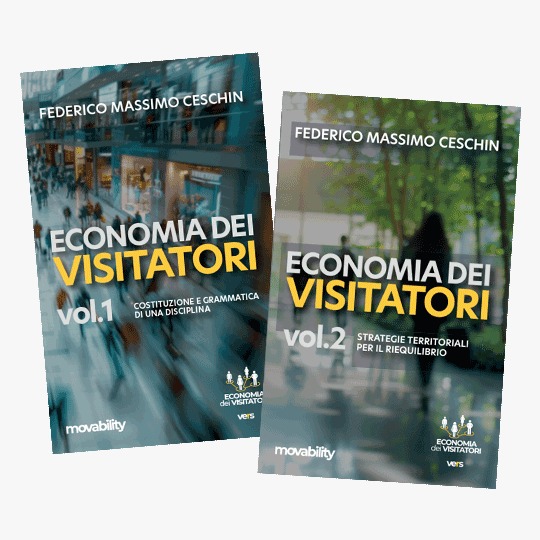
Beyond records: what is tourism really worth?
Records tell us how much is moving; they tell us little about how much remains. In 2024, Istat recorded 139.6 million arrivals and 466.2 million overnight stays in accommodation establishments, with international guests accounting for more than half of demand. These were all-time highs, and Italy ranked second in Europe after Spain. The global picture is different. Until the 1980s, Italy ranked first for international arrivals; today it is fifth. It will soon fall to seventh, perhaps eighth place: we are growing in absolute terms but continue to lose market share.
The value that remains can be measured with three tools. Leakage and the local multiplier show how much spending flows out and how many times the rest circulates locally. The “K-country coefficient” measures the state’s presence in essential services. VERI looks at five dimensions: retained economic value, community vitality, ecological integrity, cultural richness and capacity for the future. It tracks them over time, comparing a territory with itself.
Carrying capacity, in turn, sets limits across three dimensions: ecological, infrastructural and social. The total is multiplied by “K-country”, because where the state is absent every threshold collapses. The Doxey Index signals when residents’ welcome turns into irritation. For this reason, carrying capacity must be read as a threshold specific to each territory, not as one number that applies everywhere.
VERA, VERI and VERS: from theory to experimentation
They are three steps on the same scale: an alert, an index and a strategy, with a Master Plan to put them into practice.
VERA is operational. It uses only open national data that are complete at municipal level: ISPRA municipal waste, housing from the 2021 Census and Istat accommodation capacity. It requires nothing from the municipality. It places each municipality in one of four quadrants (extractive tourism, depopulation, full residential use, occasional residential use) and flags when a result is unstable. It is a compass, not a ranking, built around indicators that pass the “councillor’s test”: data the municipality already has or that are publicly available. The open issue is the share of each euro retained at municipal scale, which public data alone cannot establish.
For Halaesa Nebrodi, I would start as follows:
- Apply VERA to the seven municipalities as one territory, without ranking them against one another. In small municipalities, tourism movement is often suppressed in published data because it falls below the reporting threshold; that is why VERA uses footprints.
- Present the findings to all seven mayors together, at a joint steering group. Individual meetings could be read as a ranking.
- Begin with a “zero phase” in five steps: name the problem, map the actual stakeholders, check whether relationships have sufficient critical mass, set non-negotiable limits, and choose the lightest workable structure.
- Walk with the people who actually safeguard the territory and ask three questions: What do you safeguard that no one else can safeguard in your place? What would happen if you stopped doing this? What would you like people to recognise about your role, socially and economically?
From VERA, the work can move to VERI—if a municipality asks for it—to define the resource-consumption index, which can then inform a VERS, or regeneration strategy.
How can we manage and guide change towards 2040?
We must stop counting only arrivals and overnight stays. We need new parameters and indicators that can measure retained value. This is the gap that the Visitor Economy proposes to fill.
The risk for Italy is to create a new promotional mandate for DMOs in law just as the model from which they originated—the United Kingdom—is undergoing a major rethink. Here is what I would do now:
- Write legislation around the DMO’s mandate before settling on its name: tools and evaluation must match, or the organisation will optimise its indicators and lose sight of the strategy.
- Establish uniform levels and accreditation criteria to avoid twenty different models.
- Include an indicator of retained value alongside visitor flows in every accreditation system.
- Give small municipalities an intermunicipal task force with technical, coordinating and institutional liaison responsibilities.
- Train destination managers as a professional role; it is currently absent from Italy’s training frameworks at every level.
The Visitor Economy and the GMT™ Model
The affinities are clear: territorial identity as a starting point, communities becoming welcoming through a participatory process, and a focus on small municipalities. Andrea Succi and I worked together on the book The New Role of DMOs.
I see a division of responsibilities. GMT builds a welcoming community from within. The Visitor Economy adds three things: a clear-eyed assessment of the starting point (VERA), a way to measure over time whether the process is regenerative (VERI), and a governance framework for municipalities that lack staff to act alone (a community pact and an intermunicipal task force).
Doubling the number of international travellers by 2040 will not automatically benefit small municipalities. Projections also point to greater concentration: a few urban and coastal hubs, and platforms retaining a growing share of the margin. By 2040, places with a strong identity and shared governance will be able to attract a more widely distributed flow of visitors and retain its value. Others will see more visitors in territories increasingly emptied of the people who care for them. That is why I see the two approaches as distinct but coordinated: GMT as the engine of identity and hospitality; the Visitor Economy as a system-wide measure and a set of rules for distributing value across the different sectors of the local economy.
Riccardo Zingone 30/07/2026 1
I dati ISTAT relativi al periodo 2020-2025 confermano una forte crescita dell’offerta ricettiva turistica di Halaesa Nebrodi. Ma occorre fare di più.
Il territorio di Halaesa Nebrodi è cresciuto. Adesso deve diventare una Destinazione.
Ci sono numeri che descrivono una realtà. E poi ci sono numeri che invitano a cambiare prospettiva. Quelli relativi alla crescita della ricettività del comprensorio del GMT Halaesa Nebrodi appartengono a questa seconda categoria. Nel giro di appena cinque anni siamo passati da 34 a 207 strutture ricettive e da 638 a 1.575 posti letto. Stiamo descrivendo una crescita legata sostanzialmente all'extralberghiero e non sono semplici statistiche: sono la testimonianza di centinaia di persone che hanno deciso di investire qui, ristrutturando immobili, aprendo B&B, case vacanza e affittacamere. Hanno investito perché hanno creduto nelle potenzialità del territorio. Ed è forse proprio questa la notizia più importante.
Dietro i numeri c'è la fiducia
Sarebbe stato utile incrociare questi dati con arrivi e presenze Comune per Comune lungo tutto il quinquennio. Purtroppo non disponiamo ancora di una serie storica completa. Eppure è difficile immaginare che oltre 170 nuove strutture siano nate senza una domanda crescente. Chi investe non lo fa per caso. Evidentemente il nostro territorio ha iniziato ad attrarre un numero sempre maggiore di viaggiatori.
Nel confronto nato dopo la pubblicazione dei dati su Facebook , il sindaco di Tusa Angelo Tudisca ha ricordato come questa crescita sia stata favorita anche dal lavoro delle amministrazioni: valorizzazione del patrimonio culturale e archeologico, qualità dei servizi, programmazione, turismo accessibile, rigenerazione urbana e attenzione alla destagionalizzazione. È una riflessione che condivido. L'iniziativa privata trova terreno fertile quando incontra amministrazioni capaci di creare condizioni favorevoli allo sviluppo.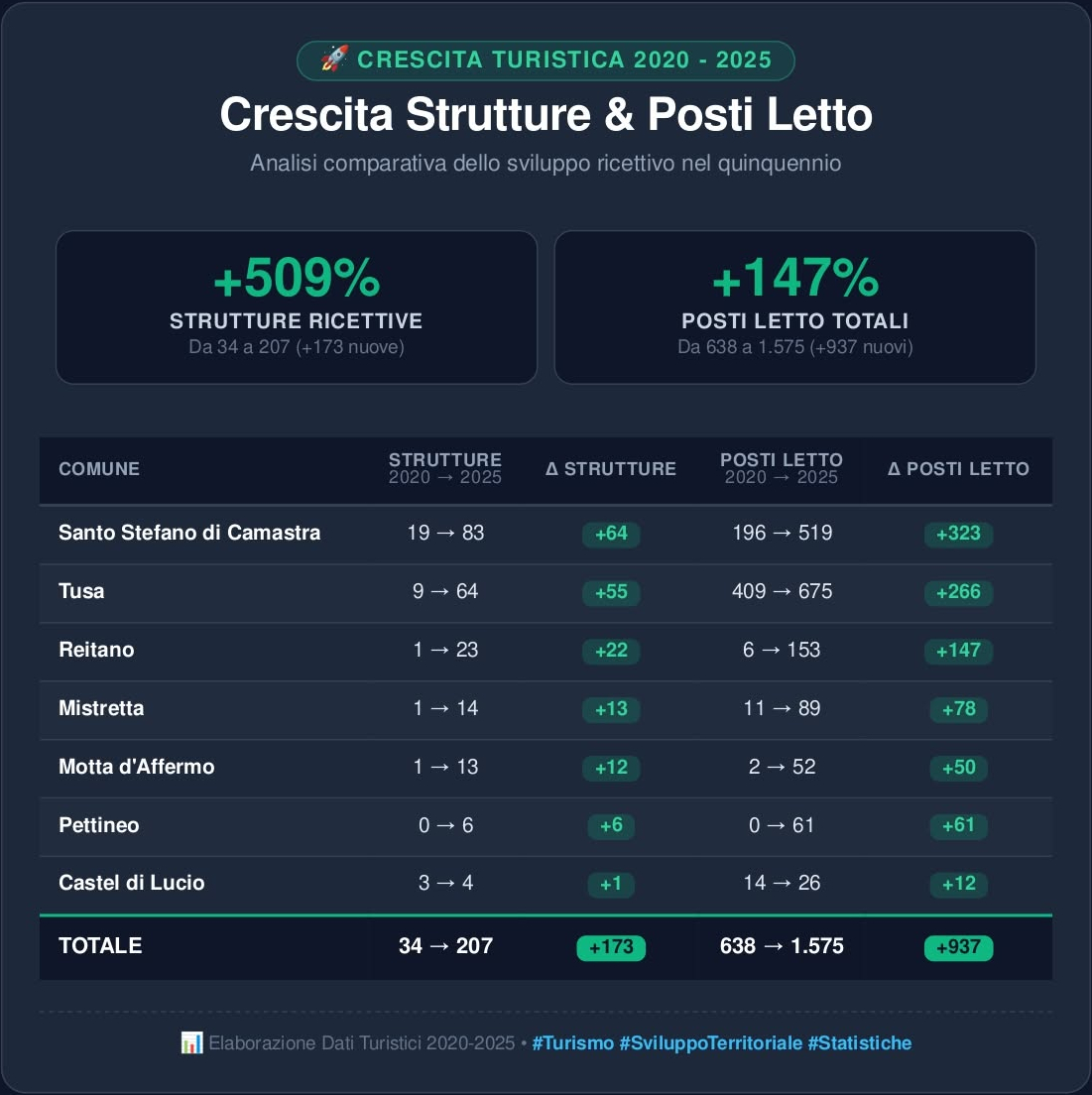
La seconda fase inizia adesso
Il punto, però, oggi è un altro. Il vero interrogativo non è come siamo arrivati fin qui, ma come fare in modo che questa crescita non resti un episodio irripetibile. Finora lo sviluppo è stato in larga parte spontaneo, pur sostenuto dalle azioni dei singoli Comuni. Da adesso in avanti la sfida cambia: non basta più aumentare i posti letto, bisogna riuscire a tenerli occupati durante tutto l'anno.
Quando nasce una destinazione
È qui che si comprende la differenza tra una meta e una destinazione turistica. Il turista può scegliere di visitare un borgo specifico. Ma quando è un intero territorio ad affascinarlo attraverso la propria storia, il paesaggio, le tradizioni, il patrimonio culturale e le esperienze che è capace di offrire, allora il singolo paese non rappresenta più il fine del viaggio: diventa una tappa di un racconto più ampio. È in quel momento che nasce una destinazione.
Per questo serve una regia condivisa: una narrazione comune, un calendario coordinato, itinerari intercomunali, prodotti turistici prenotabili, formazione, raccolta dei dati e strumenti comuni di promozione e commercializzazione. Lo sviluppo, infatti, non va soltanto favorito: va governato.
Le differenze possono diventare una forza
La diversa crescita registrata tra i Comuni non va letta come uno squilibrio, ma come un'opportunità. Tusa, Santo Stefano di Camastra, Reitano, Mistretta, Motta d'Affermo, Pettineo e Castel di Lucio possiedono identità differenti e complementari. Le destinazioni più competitive non uniformano i territori: li mettono in relazione. Mare, archeologia, ceramica, borghi, boschi, gastronomia e tradizioni, se collegati tra loro, diventano un unico prodotto turistico.
La vera sfida è adesso
I dati del quinquennio 2020-2025 dimostrano che il territorio possiede un potenziale reale. Adesso occorre compiere un salto di qualità: trasformare una crescita spontanea in uno sviluppo organizzato, misurabile e condiviso.
Se siamo riusciti a ottenere questi risultati lavorando prevalentemente come singoli Comuni, viene naturale chiedersi quali traguardi potremmo raggiungere iniziando finalmente a ragionare come un'unica destinazione. È una domanda che riguarda amministratori, operatori economici e comunità locali. Ma, soprattutto, è una domanda alla quale non possiamo più permetterci di non dare una risposta.
Uno sguardo dalla Sardegna
Giovanni Antonio Sanna, mio collega Coordinatore Turistico Territoriale di Territori e Italianità, impegnato nella costruzione di reti territoriali in Sardegna, attraverso il GMT Sardinia HUB, legge questi dati con una chiave di interpretazione che va oltre i numeri:
«La crescita quantitativa dell'offerta non garantisce automaticamente la crescita del valore generato per le comunità. Senza una visione condivisa si rischia di restare semplici fornitori di servizi. Un territorio competitivo nasce quando amministrazioni, operatori e comunità imparano a lavorare come un unico sistema, trasformando tante iniziative individuali in un'unica esperienza territoriale.»
Una riflessione che trova piena applicazione anche nel comprensorio Halaesa Nebrodi, dove la prossima sfida non sembra essere tanto quella di aumentare ulteriormente il numero delle strutture ricettive, quanto quella di costruire una vera destinazione turistica capace di generare valore, occupazione e presenze durante tutto l'anno.
halaesanebrodi 06/12/2024 0
L'Azienda agricola "Il Melograno" a Dolcemente Castelbuono
Al via la nuova edizione di Dolcemente Castelbuono che si terrà nei giorni 6, 7, 8, 14 e 15 dicembre proprio al centro della ridente cittadina madonita.
Un evento durante il quale, lungo la centrale via Sant'Anna, sarà possibile visitare ben 4 aree espositive: l'Area Village, l'Area Street food, l'Area Handmade e l'Area Dolcemente.
In quest'ultima, dopo aver superato una rigorosa selezione, potrete incontrare una delle aziende partner del GMT™ Halaesa Nebrodi: l'Azienda Agricola "Il Melograno" di Motta d'Affermo.
In collaborazione con il gruppo di cooperazione "Mediterraneo", vi delizieranno con una selezione di confetture, mieli, aromatiche, frutta secca e tropicale.
Per saperne di più, vi invitiamo a visitare il sito ufficiale: httphttps://dolcementecastelbuono.it/ una ricca programmazione di eventi ricreativi vi aspetta!!!
Halaesa Nebrodi 14/09/2024 0
Un Piano d'azione per Halaesa-Nebrodi
Vogliamo che il nostro territorio, identificato come Halaesa-Nebrodi, sia coeso e lavori verso un progetto di sviluppo rigenerativo comune: diventare destinazione turistica.
Questo è il tema fondamentale che ha ispirato la genesi della visione e i due momenti che ad essa sono seguiti: il convegno sulla Cultura dell'ospitalità nelle aree interne del 26 gennaio di quest'anno e la presentazione del GMT™Halaesa-Nebrodi col relativo sito, avvenuta appena tre mesi dopo, il 29 aprile.
Sono stati mesi intensi e impegnativi costellati da incontri, scambi d'idee, interazioni e crescita che hanno creato le basi per sviluppare ed integrare il progetto per approdare, quindi, alla tappa di sabato 21, ospiti del comune di Castel di Lucio e del sindaco Giuseppe Giordano che ringrazio per la disponibilità e per la condivisione della visione.
L'evento è diviso in due momenti distinti che, tuttavia, si integrano l'uno con l'altro: il primo è rivolto ai Sindaci del territorio, il secondo agli operatori.
Nell'incontro mattutino, insieme ai Sindaci, cominceremo a definire e conoscere lo strumento fondamentale attraverso il quale potremo avviare un percorso rigenerativo, in chiave turistica, del nostro territorio: il Piano d'azione per il territorio di Halaesa-Nebrodi.
Sarà un primo momento di ascolto e di confronto durante il quale condivideremo le istanze e le progettualità proposte dalle singole amministrazioni comunali integrandole e incrociandole con la nostra visione di sviluppo turistico e trasformativo del territorio.
I Sindaci e gli amministratori tutti, in quanto veri ed autentici conoscitori del proprio territorio, sono gli elementi fondamentali dai quali partire per redigere un efficace e convincente Piano d'azione: il loro ascolto, ma anche il reciproco ascolto, è il presupposto fondamentale per conoscere quali misure essi hanno intrapreso e intendono intraprendere per sviluppare turisticamente il proprio comune e dalla loro voce ascolteremo e condivideremo anche le criticità sulle quali bisogna lavorare per migliorare la qualità di vita di residenti e visitatori.
Attraverso la community di Territori e italianità e grazie alla grande esperienza maturata negli anni da Andrea Succi cercheremo di individuare, insieme, quale sarà la strada percorrere e quali le iniziative da intraprendere utili alla crescita del nostro territorio, in un'ottica condivisa che tenga conto delle peculiarità di ciascun comune, incanalata nell'alveo di un progetto complessivo che abbia come obiettivo finale quello di diventare destinazione turistica.
L'evento pomeridiano che, come dicevo prima, si interseca col primo, è rivolto a tutte le attività che, a titolo diverso, operano o intendono operare nel settore turistico. Un'offerta turistica integrata ha bisogno di numerosi attori: ristoratori, strutture ricettive, artigiani, guide turistiche e naturalistiche, associazioni, info-point, botteghe con prodotti tipici e souvenir, attività commerciali, professionalità turistiche, servizi turistici e, non vi sembri una forzatura, semplici cittadini disposti ad accogliere i visitatori con un sorriso. Tutto questo fa di noi una Comunità ospitale, ovvero il frutto di una virtuosa collaborazione che sia sinonimo di qualità, sostenibilità e calore umano perché insieme promuoviamo un turismo sostenibile e inclusivo, valorizziamo il territorio e miglioriamo l'offerta turistica attraverso un'accoglienza di qualità.
Nella veste di CCT™ di Halaesa-Nebrodi ringrazio fin d'ora le decine di operatori coinvolti che hanno già sposato con entusiasmo il progetto che ho loro proposto e, alla luce di queste e altre considerazioni, invito tutti gli operatori del territorio Halaesa-Nebrodi che non ho potuto ancora raggiungere a partecipare all'incontro pomeridiano che inizierà alle 15.30 presso il Teatro Nino Martoglio così da conoscere a fondo il nostro progetto, convogliando le nostre e le vostre energie positive in un percorso di crescita il più esteso e condiviso possibile.
Conosci gli Operatori e il Progetto del GMT˜Halaesa-Nebrodi.