Castel di Lucio: Enter the Labyrinth, Discover Rural Sicily

Castel di Lucio: a stone village between art and the Nebrodi
Perched approximately 750 metres above sea level on a ridge overlooking the Tusa river valley, Castel di Lucio is a small village in the western Nebrodi where landscape, stone and contemporary art seem to belong to a single story.
Its narrow streets climb towards the remains of the ancient castle. From above, the view stretches across the mountains and inland valleys and, on the clearest days, reaches the Tyrrhenian Sea.
Let us design your journey together
Castel di Lucio is not simply another stop to add to an itinerary. It is a place to discover slowly, bringing together art, nature, traditions and local flavours.
Contact the Halaesa Nebrodi team. We will listen to your interests and design a personal travel experience with you, introducing you to the village and its surrounding territory.
Message us on WhatsApp Contact us by email
From the castle to the stone village
The origins of Castel di Lucio are not documented with certainty, although institutional sources trace them back to the Norman period. For a long time, the village formed part of the Mistretta feudal estate before becoming an independent community in the eighteenth century.
Only one tower remains of the ancient castle attributed to the Ventimiglia family, built in a strategic position at the top of the hill. The streets of the historic centre converge towards it, making it one of the best places from which to understand the village’s distinctive layout.
The Torre di Migaido, dating from the thirteenth century, also stands within the municipal territory. It was once a fortified Ventimiglia settlement and a lookout point along the route connecting Castel di Lucio with Motta d’Affermo.
Stone accompanies visitors throughout the village. Doorways, arches and carved keystones preserve the memory of local stonemasons and a craft tradition that left a distinctive mark on its architecture.
Churches and community memory
The Mother Church, dedicated to the Madonna delle Grazie, preserves works connected with the village’s religious and artistic history, including a stone ciborium attributed to the Gagini school.
The Church of San Nicola, built below the ancient castle, belongs to the oldest part of the settlement. Other religious landmarks include the church and convent of Maria Santissima del Soccorso, the Church of Sant’Antonio da Padova, the Church of Santa Lucia and smaller sacred buildings found throughout the village and countryside.
Paintings, statues, wooden artworks and textiles dating from the fifteenth century onwards reflect a devotion that continues through the community’s celebrations and traditions.
Castel di Lucio within Fiumara d’Arte
In Castel di Lucio, contemporary art is not separated from the landscape. It enters the village, meets its streets and transforms the territory into a space for experience and reflection.
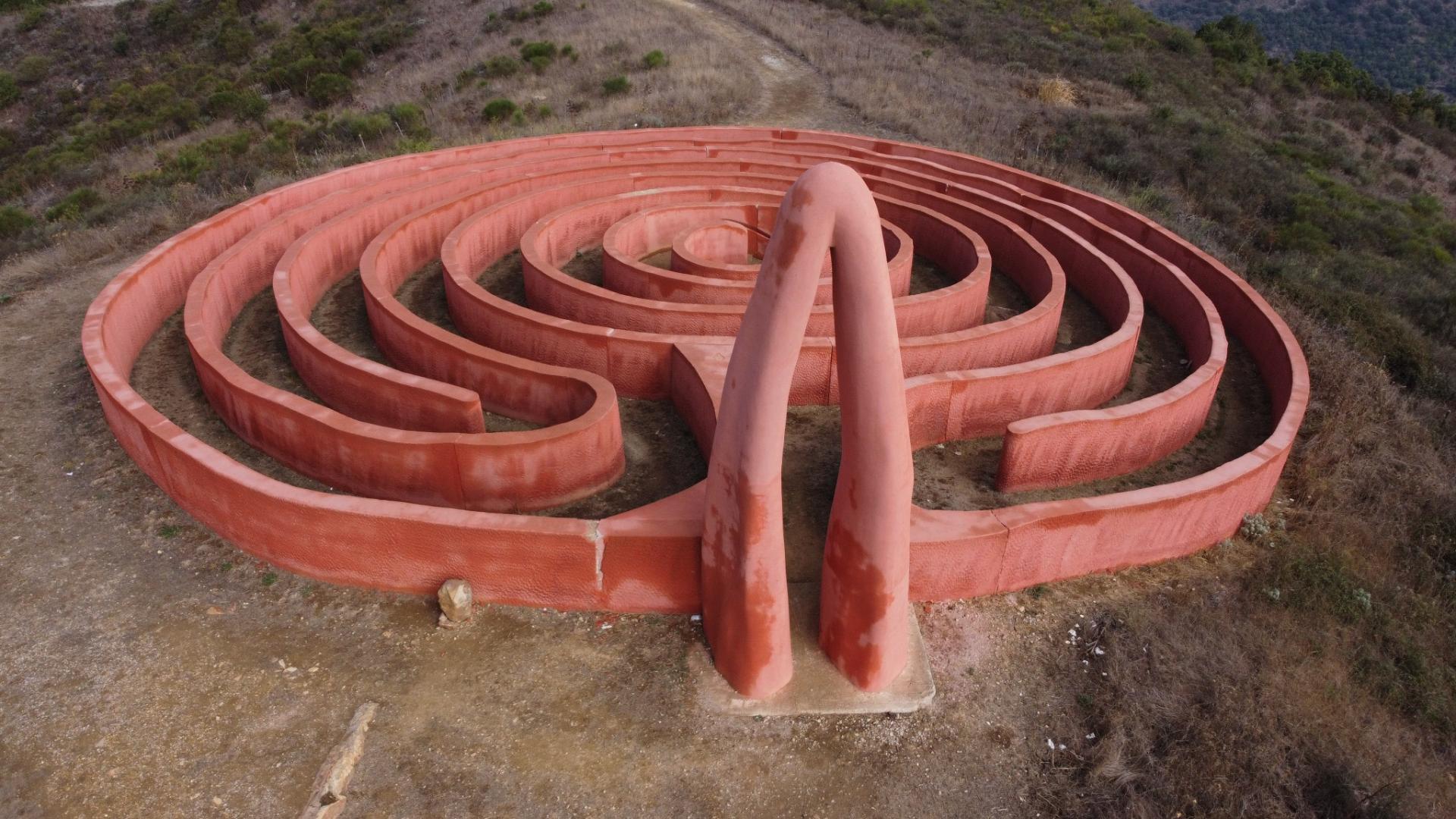
The Labirinto di Arianna (Labyrinth of Ariadne), created by Italo Lanfredini in 1989, is one of Fiumara d’Arte’s best-known works. Its archetypal form invites visitors on both a physical and inner journey: entering the structure, following its spiral and reaching a centre that evokes life, earth and rebirth.
Within the village stands Arethusa, created by Piero Dorazio and Graziano Marini in 1989. Its polychrome ceramics cover the façade of the Carabinieri station, transforming an institutional building through colour and light.
Along the road leading to the village, visitors encounter Una curva gettata alle spalle del tempo (A Curve Cast Behind Time), created by Paolo Schiavocampo in 1988. Positioned where two roads meet, the work becomes part of the movement of the surrounding landscape.
These three works make Castel di Lucio one of the essential places for understanding Fiumara d’Arte: a dispersed museum where art inhabits everyday spaces and enters into dialogue with the natural environment of the Nebrodi.
Trails, forests and horizons
The area surrounding the village contains forests, pastures, valleys and waterways. Routes identified by the Municipality offer access to different landscapes:
- Bosco San Giovanni, reached through pastures and historic farmsteads;
- the Calvario Trail, leading to a natural terrace overlooking the Tyrrhenian Sea, the Nebrodi and the Madonie;
- the Spirito Santo Trail, following the old road to Mistretta towards a rural church, the Tusa river, the remains of an ancient bridge and a former watermill;
- Monte Grillo, locally called Timpa d’Ariddu, the highest point in the municipal territory and one of its broadest viewpoints.
Visitors should check conditions and accessibility in advance and determine whether a local guide is advisable.
The “Donna Concettina Stimolo” Palmento
In 2026, Castel di Lucio returned to the community a place deeply connected with its rural heritage: the “Donna Concettina Stimolo” Palmento, a traditional wine-production building.
Restored after a long period of abandonment and inaugurated on 11 August, it has become a museum section dedicated to the memory of agricultural work, wine production and rural life.
More than the preservation of an old production facility, the project recovers part of the village’s collective history: a place where spaces and objects can once again tell the story of the relationship between the community, the land and its traditions.
A culture rooted in the land and livestock farming
Agriculture and livestock farming have shaped Castel di Lucio’s landscape and economy for centuries. Cereals, pulses and olive trees coexist with a livestock tradition based mainly on sheep, goats and pigs.
This pastoral culture produces cheeses such as Provola dei Nebrodi and caciocavallo, preserving the direct relationship between pastures, animals and traditional craftsmanship.
The murriti are particularly distinctive: small figures shaped by cheesemakers from fresh tuma cheese. Doves, horses and other forms, once often made for children, transform cheesemaking into an expression of popular creativity.
Celebrations and traditions
Religious celebrations, Carnival and Holy Week rituals continue to shape the community calendar. The most important occasions include the feast of the patron San Placido, celebrated in August, and devotion to the Madonna del Soccorso.
These events bring the village together and reveal a heritage of relationships, gestures and memories that cannot be understood simply by looking at its monuments.
Why discover Castel di Lucio?
- To explore a historic centre shaped by stone.
- To reach the remains of the castle and the village’s panoramic viewpoints.
- To encounter three important works of Fiumara d’Arte.
- To follow trails through forests, valleys and historic rural architecture.
- To discover the agricultural and cheesemaking culture of the Nebrodi.
- To experience the authentic life of a small local community.
Your journey begins before you arrive
Follow Halaesa Nebrodi on Facebook and Instagram for images, stories, events and travel ideas dedicated to the seven communities.
Follow us on Facebook Discover Halaesa Nebrodi on Instagram
Ready to turn inspiration into a journey?
You do not have to organise everything yourself. Tell us how you imagine your stay: the Halaesa Nebrodi team will help you design your ideal journey.