Pettineo: The Rural Soul of the Halaesa Valley

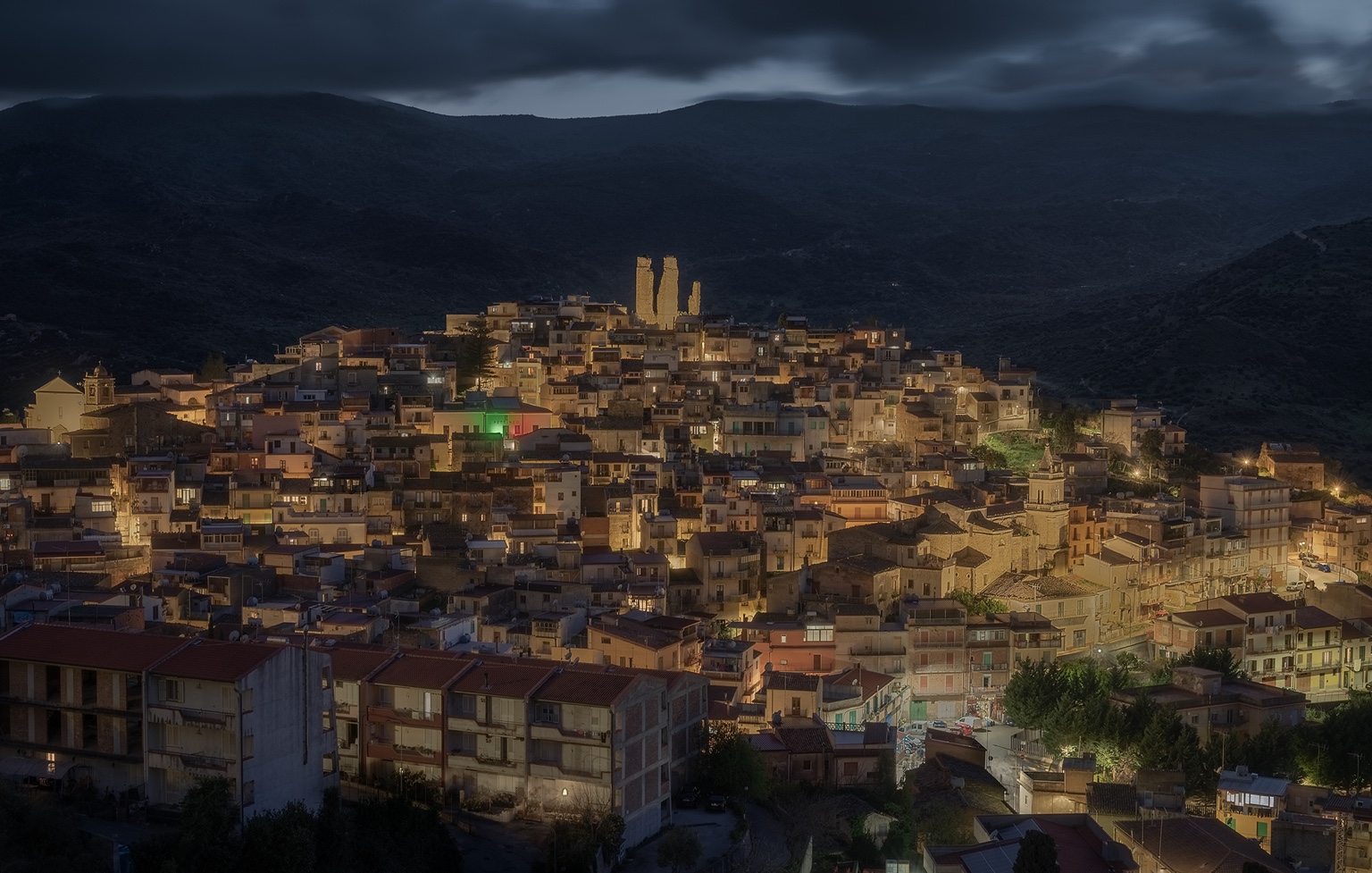
Pettineo: the village of house-museums and Limone in Seccagno
At the foot of Monte San Cuono, between the Tusa and Santo Stefano rivers, Pettineo overlooks the landscape of the western Nebrodi.
Photo credit: Ludovico Orsini
It is a compact village of narrow streets, courtyards and historic architecture, where agricultural identity meets a distinctive form of contemporary art spread throughout the community.
Here, artworks do not exist only in public spaces. They enter private homes, are cared for by local families and become part of the community’s everyday life.
Start designing your journey with us
Tell us what you love, how much time you have and how you would like to experience Sicily. The Halaesa Nebrodi team will help you create your ideal journey.
Message us on WhatsApp Contact us by email
From the castle to the medieval village
Pettineo’s documented history begins in the Middle Ages. In the thirteenth century, the settlement of Pectineum was granted by King Manfred to Manfredi Maletta. The territory later passed through several feudal families before coming under the control of the Counts of Prades and the Ventimiglia family.
During the early fourteenth century, the castle was fortified and became the centre of the settlement. Narrow streets, courtyards and gateways developed around the defensive structure.
Some remains of the castle are still visible in the upper part of the village and are recognised for their historical, artistic and architectural importance.
Piazza Duomo and religious heritage
Piazza Duomo is one of the central points of a visit to Pettineo. Here stands the Church of Maria Santissima delle Grazie, built during the sixteenth century and consecrated in 1579.
In front of the Mother Church stands an allegorical statue of Fortitude, known locally as “a Custanza ’a chiazza”. It was created in 1639 by Pettineo-born sculptor and engineer Geronimo d’Ajeni to celebrate the community’s newly acquired right to administer civil and criminal justice.
The female figure embracing a column has become one of the village’s symbols.
Sant’Oliva and “A Vutata di l’Altari”
The church dedicated to Sant’Oliva, Pettineo’s patron saint, was built in the sixteenth century and later altered.
It preserves works including frescoes painted by Giuseppe Brusca in 1822, the saint’s processional structure dating from 1786 and a sixteenth-century statue of the Madonna della Neve.
During the patronal celebration on 5 May, “A Vutata di l’Altari” is renewed: a distinctive scenic structure in which two angels accompany the statue of the saint towards the top of the altar.
It is one of the most representative expressions of Pettineo’s devotion and community identity.
The Capuchin Convent
Founded in 1579, the Capuchin Convent preserves the simplicity associated with Franciscan architecture.
Its church contains the altarpiece Madonna degli Angeli, painted by Guglielmo Borremans in 1722. The crypt houses the mummified bodies of several friars and members of the local nobility.
The complex also includes an old seedbed divided into eight basins, a rare feature connected with the agricultural and community life of the convent.
Migaido and the ancient Wheat Route
Outside the village, the territory preserves the fortified Migaido complex, with its fourteenth-century tower, keep and chapel decorated with frescoes representing Christ Pantocrator.
The Ponte Migaido also stands in this area. Designed by architect Giovan Battista Vaccarini and built in 1750, the bridge provided an important crossing over the Tusa river along the historic route connecting the Tyrrhenian coast with inland Sicily, associated with the ancient Wheat Route.
Nearby, traces remain of a mill that once used the waters of the river.
One kilometre of canvas and the Museo Domestico
Pettineo’s relationship with Fiumara d’Arte is different from the monumental sculptures found in other municipalities.
In 1991, Antonio Presti invited numerous artists to paint a one-kilometre-long canvas laid out along the village streets. At the end of the day, the canvas was divided and the artworks were given to the families who had hosted the artists.
This gave rise to the Museo Domestico, a dispersed museum preserved inside private homes. The houses can be recognised by ceramic plaques displaying the name of the family and the artist.
The experience was repeated in 1992, 1993 and 1995, transforming residents from spectators into custodians of art.
In Pettineo, Fiumara d’Arte is therefore not simply a route to observe: it is an encounter between visitors, artworks and the local community.
Contemporary art continues through the village
The dialogue with contemporary art also continues through Flusso dinamico (Dynamic Flow), the mural created in Via Credenza in 2025 by Palermo artist Andrea Buglisi.
The work presents sport as a universal language, an instrument of inclusion and an opportunity for people and cultures to meet.
The project involved young people, residents and students, confirming Pettineo’s ability to turn art into a collective experience.
Limone in Seccagno
The product most closely connected with Pettineo’s agricultural identity is the Limone in Seccagno, a lemon cultivated with significantly less water than conventional citrus farming.
Production takes place in the territories of Pettineo and Tusa and is recognised among Sicily’s Traditional Agri-food Products. The fruit is distinguished by its fragrance and storage qualities.
The Sagra del Limone Seccagno, known in recent editions as Seccagno Days, celebrates this product. Tastings, local recipes, performances and events dedicated to territorial products animate the historic centre.
Why visit Pettineo?
- To explore the streets of the village beneath the remains of its castle.
- To discover the Museo Domestico created through One Kilometre of Canvas.
- To learn about its religious heritage and “A Vutata di l’Altari”.
- To visit the historic Migaido complex.
- To see the mural Flusso dinamico.
- To discover and taste the Limone in Seccagno.
- To meet a community that has transformed hospitality into cultural participation.
Your journey begins before you arrive
Follow Halaesa Nebrodi on Facebook and Instagram. You will find stories, places, traditions, events and experiences that can inspire the journey we will create together.
Follow us on Facebook Discover Halaesa Nebrodi on Instagram
Ready to turn inspiration into a journey?
Tell us about the journey you imagine. We will design it together.