"Giuseppina Azzolina wins the 'Entrepreneurship and Management' Award 2025" 🏆
A deserved recognition that the 25-year-old from Castel di Lucio dedicates to her family and to the Territory
Halaesa Nebrodi 05/10/2025 0
Recognition for Youth Entrepreneurship to an Operator of Halaesa Nebrodi
The current year continues to hold pleasant surprises for the Territory, for GMT™ Halaesa Nebrodi, and for the Operators who are part of it.
After recently telling the story of Elisa Cerrito and the Il Melograno Farm in Motta d'Affermo, which won a prestigious award in the field of beekeeping ([link to the article]), on October 4th, another young entrepreneur from Halaesa Nebrodi received an important recognition. She is Giuseppina Azzolina from Castel di Lucio, who was awarded in the context of the fourth edition of the "Una di tante" (One of Many) competition, organized by the Pro Loco of Nicosia.
Giuseppina Azzolina and her kiosk, "Al passo di Eolo" (At the pace of Aeolus), won the award in the Entrepreneurship and Management section. This important recognition was assigned following the suggestion of the Mayor of Castel di Lucio, Giuseppe Giordano, who in this way wanted to give due and deserved credit to the very young 25-year-old entrepreneur from Castel di Lucio. We recall that in the previous edition, another entrepreneur from Castel di Lucio, Franca Sacco, was awarded for her activity in the dairy sector, and in the same year, the Entrepreneurship and Management award was assigned to the entrepreneur from Mistretta, Maria Grazia Insana.
A Choice of Heart and Courage
Like many young people her age, at a certain point in her life, Giuseppina found herself at a crossroads: leave or stay? The love for her land, for her family, and for her town became determining factors in her difficult choice. Her decision was firm: Castel di Lucio, a mountain town of just over 1200 inhabitants perched on the Nebrodi Mountains, has been and will continue to be her home.
"A courageous choice, far from obvious, that has had an important impact on the entire community," underlined the Mayor during the award ceremony, "because with her gesture, she has restored dignity to the town."
The Birth of "Al passo di Eolo"
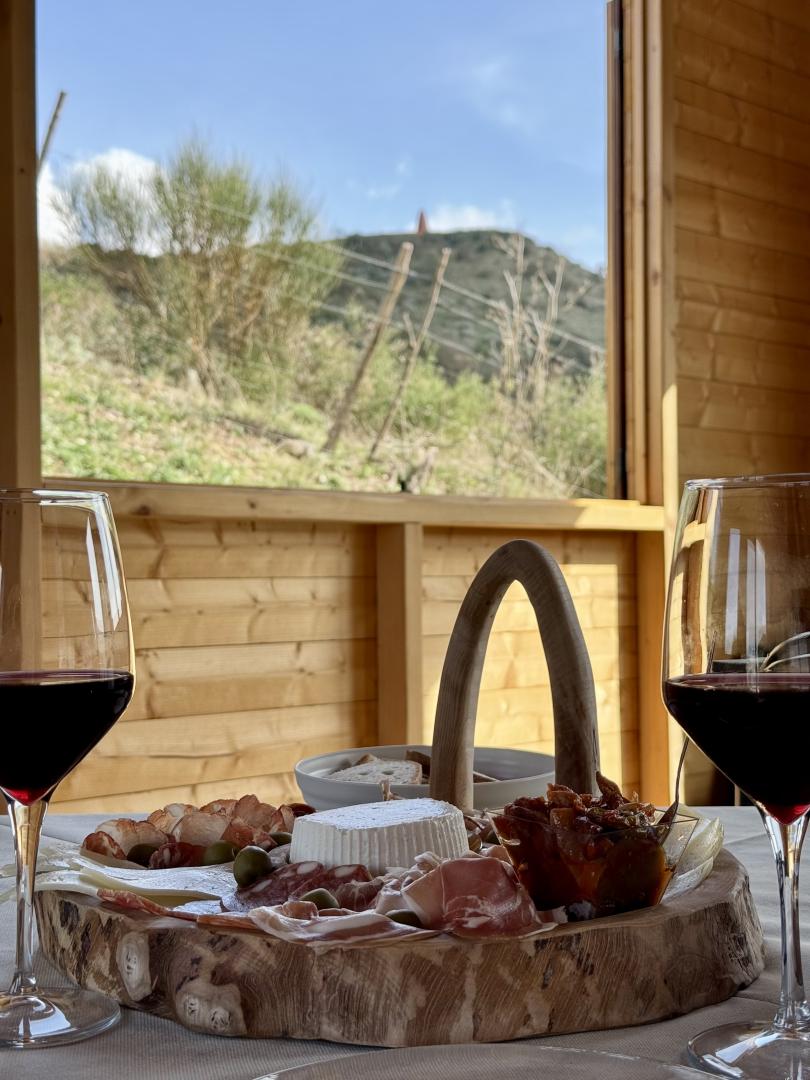
Giuseppina's family owns land a few minutes from the famous land art installation, The Labyrinth of Ariadne (Il Labirinto di Arianna), a highly frequented destination that is part of Fiumara d'Arte, Europe's most extensive open-air contemporary art park. On this land, located on a knoll exposed to the four winds with a breathtaking view, Al passo di Eolo was born in 2021, a small family-run kiosk where Giuseppina and Mimma, her dynamic mother, manage the kitchen and welcome guests.
From its beginning, Al passo di Eolo has stood out for its menus, a triumph of Sicilian cuisine: from cutting boards of fresh cured meats and cheeses to more substantial dishes like sandwiches with sausage and ricotta. There is no shortage of sweet delicacies, such as fresh cannoli, all served with refreshing drinks or a good coffee. The dishes are often presented on unique wooden cutting boards, hand-carved in the shape of a labyrinth, adding a special touch to the experience. Even on the cutting boards, there is, in a way, the family's mark, as they are handcrafted by her carpenter father who, obviously, also created all the wooden structures.
From that moment on, Al passo di Eolo became a genuine reference point for the territory and for the town of Castel di Lucio because, as the Mayor recalls, "it creates Value by uniting Art, Territory, and high-quality gastronomic Products, but it is also an important information point serving travelers."
"My award comes from a long way, the result of great sacrifices and supported by the closeness of my whole family," an emotional Giuseppina recounts. "I decided to stay and invest in the Territory, and it is to the Territory that I dedicate this award."
Beautiful words full of meaning, which aim to be an example for those who want to make their Territory their Home.
You may also like...
Riccardo Zingone 18/08/2026
I Cosi Duci – Traditional Sweets Festival in Castel di Lucio
Castel di Lucio, a member of the Authentic Villages of Italy network, hosts an evening devoted to traditional sweets and much more.
Beginning at 7:00 p.m., the event invites visitors to taste local confectionery specialities in a lively programme enriched by craft displays, music and comedy.
The promotion of traditional local products is particularly important to the community. Another major event is the Sagra du Cascavaddu, the annual caciocavallo cheese festival traditionally held on 17 August.
At 9:00 p.m., popular Catania comedian and storyteller Giuseppe Castiglia takes to the stage with his well-known jokes and cabaret performance.
Riccardo Zingone 16/01/2026
People of Halaesa Nebrodi: Chiara Dimaggio and her Domus Immobiliare Real estate Sicilia
People of Halaesa Nebrodi: Chiara Dimaggio and her Domus Immobiliare
Face to face with Chiara Dimaggio, a young and brilliant real estate agent operating in the territory of Halaesa Nebrodi.
Through her agency, Domus Immobiliare, she is fulfilling her lifelong dream: making the people she meets happy by sharing her contagious smile with them. One of her slogans says: "Life takes you to unexpected places, Love brings you Home," and Chiara, interpreting this mission with exceptional enthusiasm, has found homes for many people — both Italian and foreign — to whom, above all else, she introduced the territory, its soul, and the people who live there, adding extraordinary value to her delicate and vital work.
Chiara, what is a real estate agent doing in a local tourism marketing group?
At first glance, the role of a real estate agent within a tourism-oriented territorial marketing group might seem distant. In reality, it is not at all. The presence of a real estate agent in a territorial marketing group is not a mere formality: it is an added value. I am firmly convinced that when a town grows, all the businesses connected to it grow as well.
The core objective of GMT™ Halaesa Nebrodi is the promotion of the Halaesa Valley territory, and on this front, the group is doing an excellent job. Such extensive promotion can only bring benefits to a business like mine, which for years has invested time, energy, and passion into enhancing the value of the territory.
__.jpeg)
Yours is a young journey, yet rich with experience in the real estate sector.
My business is young, just as I am. I opened my real estate agency at only 22 years old. I remember with pleasure what pushed me to embark on this adventure. I was preparing my last three subjects for my bachelor's degree when, in a moment of high stress, I decided to change direction. It was thanks to a reflection shared by my father that I chose to attend the real estate agent course.
From there, a world opened up: my world. I became licensed for the profession, earned a bachelor's degree in Political Science and International Relations, and subsequently a master's degree in Public Administration. Today, those degrees are hanging on the wall, because the passion for my work took over and grows day by day. If I am who I am today, I owe it to the professionalism and dedication with which I perform this job. For almost 11 years, I have been making people's dreams come true, and I hope to continue doing so for many years to come.
What role do you play in GMT Halaesa Nebrodi: can you give an assessment and what are the future prospects?
I immediately embraced the GMT™ Halaesa Nebrodi project and the ideas of its creator, Andrea Succi. From the very first meeting, I was struck by his spirit, his determination, and his desire to provide a concrete contribution.
The GMT™ operates in a territory that unfortunately has experienced significant depopulation and economic regression in recent years. However, the group is made up of young entrepreneurs and professionals who deeply believe in the potential of the place where they live. In these two years, through the launch of the website, participation in the recent BTE in Palermo, constant social media promotion, and the creation of travel packages, the GMT™ has helped to make the territory known and achieve its main goal: to grow and improve the entire Nebro-Alesino district.
Will we succeed? Yes, I am certain of it. Can we do more? Absolutely. We can and must always improve, but we have all the skills to do it.
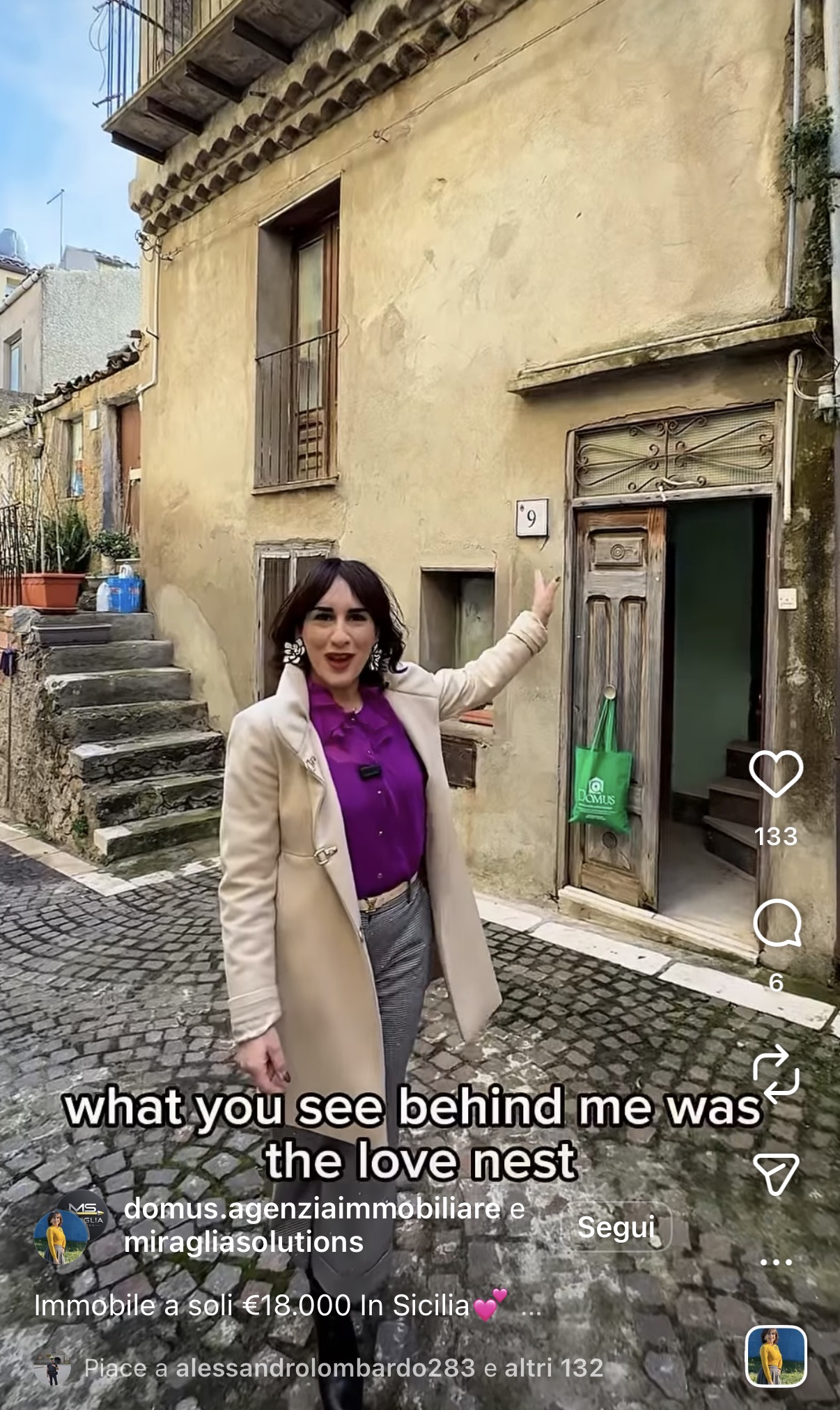
Social media and real estate: putting your face out there pays off.
The growth of my business has been strongly influenced by a constant and effective presence on social media. I say it and I will always repeat it: today, social media is decisive for the growth and image of a business. Once, newspapers were used; today everything passes through social networks, and I have fully embraced this change.
Through videos, I tell the story of the properties, but often also the stories of those who lived in them. I talk about the territory, with particular attention to Tusa, my grandparents' village, the place of my childhood and my heart. Thanks to this work — and I take credit for it — real estate transactions in the municipality of Tusa have increased exponentially, and today the village is known internationally. Putting your face out there is fundamental: people want to know who they are trusting. A logo creates distance; I, instead, build relationships based on trust, friendship, and respect.
What do you expect from the territory and what can be improved?
One of my greatest desires is to see the small villages flourish again. I imagine towns full of life, people, businesses, and lively venues. I wish that even those who live there daily would take an extra step to promote, beautify, and enhance them. I hope that local administrations can intervene with small improvements that, over time, could make a big difference.
I am very confident and, above all, proactive. Who knows, maybe our group, by joining forces, will manage to take giant leaps and surprise the territory around us. I invite anyone who wants to contribute to the growth of the territory to join the Territorial Marketing Group: together we can do great things.
Halaesa Nebrodi 03/11/2025
The GMT™ Halaesa Nebrodi present at the BTE in Palermo
The "Halaesa Nebrodi" project lands at the BTE in Palermo: a model for the regeneration of inland areas
The GMT™ Halaesa Nebrodi, launched just two years ago, is preparing for a significant milestone and on November 15th and 16th, it will be a protagonist at the BTE – Borsa del Turismo Extralberghiero (Non-Hotel Accommodation Tourism Exchange) in Palermo, a key event for the sector that will be held at the Cruise Terminal.
Reaching this important stage has not been easy. Its success is the result of the enthusiasm of local operators and the fundamental economic contribution of two sensitive and motivated sponsors: Mammana Group and Azienda Sacco Franca. Thanks to this synergy, the Territory will be present through an integrated tourism proposal, the result of the valuable scouting, organization, and coordination work carried out by the CTT™ of Halaesa Nebrodi.
The BTE: A Benchmark for Tourism Sustainability
Now in its 9th edition, the BTE – Borsa del Turismo Extralberghiero is organized by Confesercenti Sicilia with the patronage and collaboration of important institutions, including the Region of Sicily – Department of Tourism, Sport and Entertainment, the City of Palermo, the Metropolitan City of Palermo, and OTIE (Observatory of Tourism in the European Islands).
The event has consolidated its leadership in central-southern Italy, best interpreting the needs of those promoting tourism sustainability, with a particular focus on inland areas and territories less frequented by traditional tourist routes. The BTE acts as a crucial link between accommodation facilities, tour operators, travel agencies, experience promoters, and travelers. For the GMT™ Halaesa Nebrodi, participation in this Exchange therefore represents a natural and important point of arrival.
An Intensive Journey to Build the Tourist Destination
The GMT™ Halaesa Nebrodi intended, from the outset, to create and strengthen its brand as an authentic Tourist Destination. The journey has been intense and full of fundamental stages:
-
January 26, 2024: Official presentation of the project in Mistretta during the Sicilian stage of the Gran Tour dell’Ospitalità organized by Territori e Italianità, a community of professionals conceived and coordinated nationally and internationally by Andrea Succi with the aim of promoting the Cultural and Tourism Regeneration of inland areas.
-
April 29, 2024: Presentation of the official website www.halaesanebrodi.it in Castel di Tusa.
-
September 21, 2024: Meeting in Castel di Lucio, during which an Action Plan was proposed to the Mayors of the Territory.
-
Spring 2025: Publication of the first Tourist Products Catalogue in collaboration with the Tour Operator Aura Mundi by Katia Mastroeni.
This work has been constantly supported by an active presence on social media channels (Facebook and Instagram), with the production of professional content thanks to the valuable collaboration of Living Sikelia and Il mondo attraverso di Salvatore Marra.
Halaesa Nebrodi: Between B2B, Exhibition Space, and Seminars
The constant commitment of over twenty Operators and the work of the CTT™ – Territorial Tourism Coordinator now converge in the participation in the BTE in Palermo, where the Halaesa Nebrodi project will be present in full form:
-
A dedicated exhibition space to meet visitors and industry professionals.
-
Access to the B2B area, essential for initiating commercial relationships with national and foreign tour operators.
-
An active presence with a speak during the seminar Strumenti bottom-up per competere (Bottom-up Tools for Competing), scheduled for Saturday the 15th at 5:30 PM. The experience of Halaesa Nebrodi will be presented as a concrete model for the regeneration of inland areas.
During the event, a promotional video of the project, created by Emanuele Torre of Torre Films, will also be presented.
A Future for Inland Areas
In un'epoca in cui le destinazioni tradizionali soffrono di overtourism, le vaste aree interne – custodi di un patrimonio materiale e immateriale di immenso valore – necessitano di modelli organizzativi efficaci. Il modello GMT™ è la risposta a una domanda turistica sempre più orientata all'esperienza autentica e al contatto intimo con le Persone e il Territorio. È un modello replicabile che intendiamo proporre su scala regionale, rafforzato dall'esperienza maturata nel nostro territorio e che può trovare ulteriore e reciproco impulso da future sinergie.
Gli anni a venire saranno cruciali per tracciare la rotta futura delle splendide comunità coinvolte.
“Viaggiare è aggiungere vita alla vita.” – Gesualdo Bufalino