Tourism in Inner Areas: A Value to Be Given Meaning
Community cohesion: A powerful response to the fragility of inner areas, countering social and economic decline
Riccardo Zingone 12/07/2025 0
Inner Areas: Italy's True Beating Heart
For several decades, the so-called Inner Areas have been a priority on the political agenda and, by reflection, in the economic and social strategies of Italian regions. Long identified as the Achilles' heel of the national nervous system, Inner Areas, geographically distant from large urban agglomerations and peripheral in terms of access to essential services like healthcare, education, and mobility, nonetheless continue to host a significant portion of the Italian population. According to a recent 2024
We're talking about the Italy of villages rich in history, culture, and traditions, populated by people with ancient wisdom, heirs to an extraordinary tangible and intangible culture. These places boast countless beauties to discover among pristine mountains and seas, local stone constructions and red tiled roofs, interwoven with ancient alleys and small squares where time seems to stand still. These villages are special places, designed to live in symbiosis with their surrounding environment. They are extraordinary settings that offer a genuine identity, where every step forward seems to powerfully transport us back in time, in a virtuous loop that appears endless. At the same time, however, these places are symbols of fragility: often marginal and marginalized, far from essential services, and thus subjected to the relentless scythe of depopulation and economic and social impoverishment.
This phenomenon has not spared the western edge of the Nebrodi area, comprising the Municipalities of Mistretta, Santo Stefano di Camastra, Reitano, Castel di Lucio, Pettineo, Tusa, and Motta d’Affermo, as evidenced by data collected between 2002 and 2022 (ISTAT). The unforgiving numbers tell us that this area experienced an average population decrease of -17%, with peaks of -30%, in terms of resident population.
It's well-known that, precisely because of the characteristics described above, Inner Areas have, in recent years, attracted the interest of numerous tourists drawn to slow, immersive, and experiential tourism. This has created the conditions for a regenerative process within the villages themselves, but given the fragile context in which it could develop, it requires careful and targeted governance and organizational structuring.
The Culture of Hospitality: A Prerequisite for Tourism
"The culture of Hospitality does not coincide with tourism, but it is its prerequisite." (Andrea Succi)
In this direction, an innovative organizational model has developed over the years, already successfully applied in various regions of Italy, and which, in 2024, landed in Sicily. We are talking about the GMT™ (Territorial Marketing Group) format and the new figure of the CTT™ (Territorial Tourism Coordinator). The project stems from the decennial work of Dr. Andrea Succi, founder of the
The GMT™ Halaesa Nebrodi and Regional Applicability of the Model
Based on these premises, in January 2024, the GMT™ Halaesa Nebrodi was launched in Sicily, coordinated by me in my role as CTT™. It encompasses the Municipalities of Santo Stefano di Camastra, Reitano, Mistretta, Tusa, Pettineo, Castel di Lucio, and Motta d’Affermo.
Nestled between the western edge of the Nebrodi Park and the eastern edge of the Madonie, the Halaesa-Nebrodi area represents a unique blend of history, art, traditions, culture, geo- and biodiversity, in an exceptional symbiosis of sea, hills, and mountains. Undoubtedly, Halaesa Nebrodi has all the credentials to become an authentic Tourist Destination. With this objective, thanks to the synergy with over twenty economic operators, it is approaching a role and identity in professional tourism as a bearer and guardian of immense tangible and intangible knowledge, exemplified by the Ceramics of Santo Stefano di Camastra, the millennia-old history of Mistretta, the archaeological excavations of Halaesa Arconidea, the secular olive trees of Pettineo, the traditions linked to rural civilization, agri-food products, and the
Cultural Regeneration as a Starting Point
The seven Municipalities are thus represented in their singularities and specificities but integrated into a broader and shared context, in the conviction that cohesion and interaction between Municipalities can lay the foundations for the cultural, social, and economic regeneration of individual realities. Halaesa-Nebrodi, thanks to the pristine beauty of its characteristic villages and their inhabitants, has long been a tourist destination. However, in our project, we intend to propose this special place as an authentic Tourist Destination, coining and strengthening a brand that arises, almost naturally, from the synergy between different communities, and which, precisely in diversity, demonstrates its strength and conveys its great attractiveness. According to this model, local identities ("campanili") should not be demolished but reinforced and instead pooled into a broader and shared project. Communities and administrators are therefore called to dialogue, interaction, and sharing to chart a new regenerative path that can counteract the social and economic decline that we all have a duty to oppose, each with our own role and expertise.
The Role of Institutions
With a view to developing a shared project, the seven administrators were asked to approve an Action Plan that can lay solid foundations for territorial tourism planning through valuable and indispensable work in study, training, awareness-raising, consultancy, and support for operators and public administration. The GMT™ model, by its nature replicable and scalable, was presented in Nicosia during an interesting workshop, sparking the interest of administrators, economic operators, associations, and the
You may also like...
Halaesa Nebrodi 15/11/2025
The promotional video for GMT™ Halaesa Nebrodi was presented at the BTE 2025 in Palermo
A great milestone for the GMT™ Halaesa Nebrodi!
This video, skillfully produced by Torrefilms and Realeyez srls, represents an important goal achieved by the GMT™ Halaesa Nebrodi in its path of territorial enhancement and promotion.
This is a project self-financed by the Operators adhering to the GMT™ Halaesa Nebrodi, also made possible thanks to the significant financial contribution of two local companies: Mammana Group and Azienda Sacco Franca.
The film was presented during the participation of GMT™ Halaesa Nebrodi at the BTE (Borsa del Turismo Extralberghiero/Non-Hotel Tourism Exchange) 2025 in Palermo.
Our sincerest thanks go to all those who contributed with passion and willingness, becoming authentic protagonists of this visual narrative and fully embodying the collaborative spirit that drives our project:
-
-Teresa Torcivia, with her extraordinary seccagno lemon granita from Pettineo;
-
-The little ones Maria Sole and Aurora, along with their mother Katia, who opened the film shoot with sweetness and spontaneity;
-
-The Chiella-Mascarello family, who made their home available during the evocative Festa della Madonna della Luce (Festival of Our Lady of Light) in Mistretta;
-
-Sebar Cafè, for offering the ideal location to enjoy an aperitif dedicated to conviviality;
-
-Carla Testa, Giuseppe Cacciato, and their very friendly group, who brightened the scenes filmed in Mistretta;
-
-Rosario Di Francesca from Castel di Lucio, a historic master cheesemaker and true artist of caciocavallo horses (murriti), along with the entire staff of Azienda Sacco Franca;
-
-Giuseppina Azzolina from Al Passo di Eolo, the delightful kiosk at the foot of the Labyrinth of Ariadne in Castel di Lucio, an authentic reference point for local gastronomy;
-
-Placido Presti, one of the last stonemasons who, with tenacity and love, continues to work in his land, keeping an ancient art alive.
Special thanks go to our territory, a true treasure chest of beauty, history, and traditions.
A precious heritage to be preserved, narrated, and passed on with pride, because only by knowing one's roots can a shared and sustainable future be built.
Riccardo Zingone 18/08/2026
Sagra du Cascavaddu – Caciocavallo Festival in Castel di Lucio
Among Castel di Lucio’s community events with strong visitor appeal, the undisputed highlight is the Sagra du Cascavaddu, held every year on 17 August and now celebrating its 32nd edition.
The historic festival was created to introduce and promote Castel di Lucio’s signature product: caciocavallo cheese. The local area has always been closely connected with livestock farming and agriculture. By preserving traditional production techniques and using high-quality milk, local cheesemakers continue to produce excellent provola and caciocavallo cheeses.
This tradition finds its most distinctive artistic expression in the Murriti. Skilled cheesemakers shape fresh tuma curd into small figures—such as doves and horses—which were once children’s toys and are now sought-after examples of local food craftsmanship. They are a unique expression of a community that remains deeply connected to its roots.
During the festival, visitors can watch the various stages of milk processing and taste freshly made curd, tuma, ricotta and caciocavallo.
The programme also features the Engium Folk Group, performing traditional Sicilian songs and dances, followed by live music from the XXL Show Orchestra.
Images from a previous edition can be viewed below.
Riccardo Zingone 20/07/2025
People of Halaesa Nebrodi: Martin Declève and his Royal Residence
The Story of Romei
The Contrada Romei, located in the territory of Mistretta, is one of the most iconic rural areas in the heart of the Nebrodi region. It's believed that, according to the descriptions by Silius Italicus and Polybius, the ancient city of Noma once stood here, and that the name "Romei" derives directly from the ancient inhabitants of this Greco-Roman city, the Nomei.
Nestled along the eastern slope that winds up towards Contrada Zupardo, near the Serravalle torrent, the former Romei feudal estate was renowned for its abundant production of grapes, citrus fruits, olive oil, and various other fruits. At one time, mulberries were also extensively cultivated here, their leaves serving as food for silkworms. The fertility of the land, combined with the mild climate, encouraged the inhabitants of Mistretta to settle here, as evidenced by the numerous ancient farmhouses still present.
After 1684, the Fief was assigned to Santo Stefano di Camastra but, following various legal disputes, a portion of it returned to the ownership of the Municipality of Mistretta. This led to a sell-off, and many lands were ceded to powerful families such as the Allegra, Natoli, Salamone, Armao, and Aversa, who built prestigious villas. Over time, this district became so populous that it warranted the presence of a detachment of Mistretta's elementary school, housed in a dedicated building where dozens of children were educated. This continued until the 1960s, as recounted and documented by Nella Faillaci, a passionate local history researcher and former head of the Municipal Historical Archive of Mistretta.
Today, the former Romei Fief is experiencing a new season: many of the old families no longer exist, but several estates have gained new life thanks to the interest of numerous new owners who have decided to make these places their home. It's from this interesting regenerative impulse that our story begins.
Palazzo Natoli-Giaconia: A Pearl Set Among Ancient Oaks and Olive Trees
I arrive for my appointment with Martin a few minutes before the scheduled time. He had informed me of a delay shortly before but had given me permission to enter the property. As soon as I step out of the car, which had until then protected me from the summer heat and isolated me from sounds and smells, I'm literally enveloped by the beauty of the place and the incessant chirping of cicadas. There are experiences that transport us back in time, and immediately I feel immersed in an unexpected situation that deserves respect: the ancient farmhouse hosting me, the "Regale dimora" (Royal Residence, as described in pencil on a wall by a guest), radiates extraordinary energy.
I feel like a guest in a place of great sanctity and, for this reason, I move on tiptoe. Even the ancient stone pavement deserves respect, and I tread upon it with circumspection.
While waiting for Martin's arrival, I wander around the courtyard of the imposing, yet well-integrated, historic residence, surrounded by ancient olive trees and dense woodland. Peering here and there, my attention is immediately captured by a spectacular fountain with the date 1761 carved into it. Water flows, and there is life. The central sculpted figure is nestled in a stone niche that still retains red decorations, a characteristic also visible along the main two-story facade, which features a spectacular double-ramp staircase leading to the upper floor. Indeed, I notice how the red with which the ground floor walls were painted is still visible on the facade, which, together with yellow and green, must have given the building a particularly elegant and classical appearance. After all, we are in the midst of Neoclassicism, and the echo of the archaeological excavations of Pompeii and Herculaneum evidently reached here too, leaving its mark on this building. 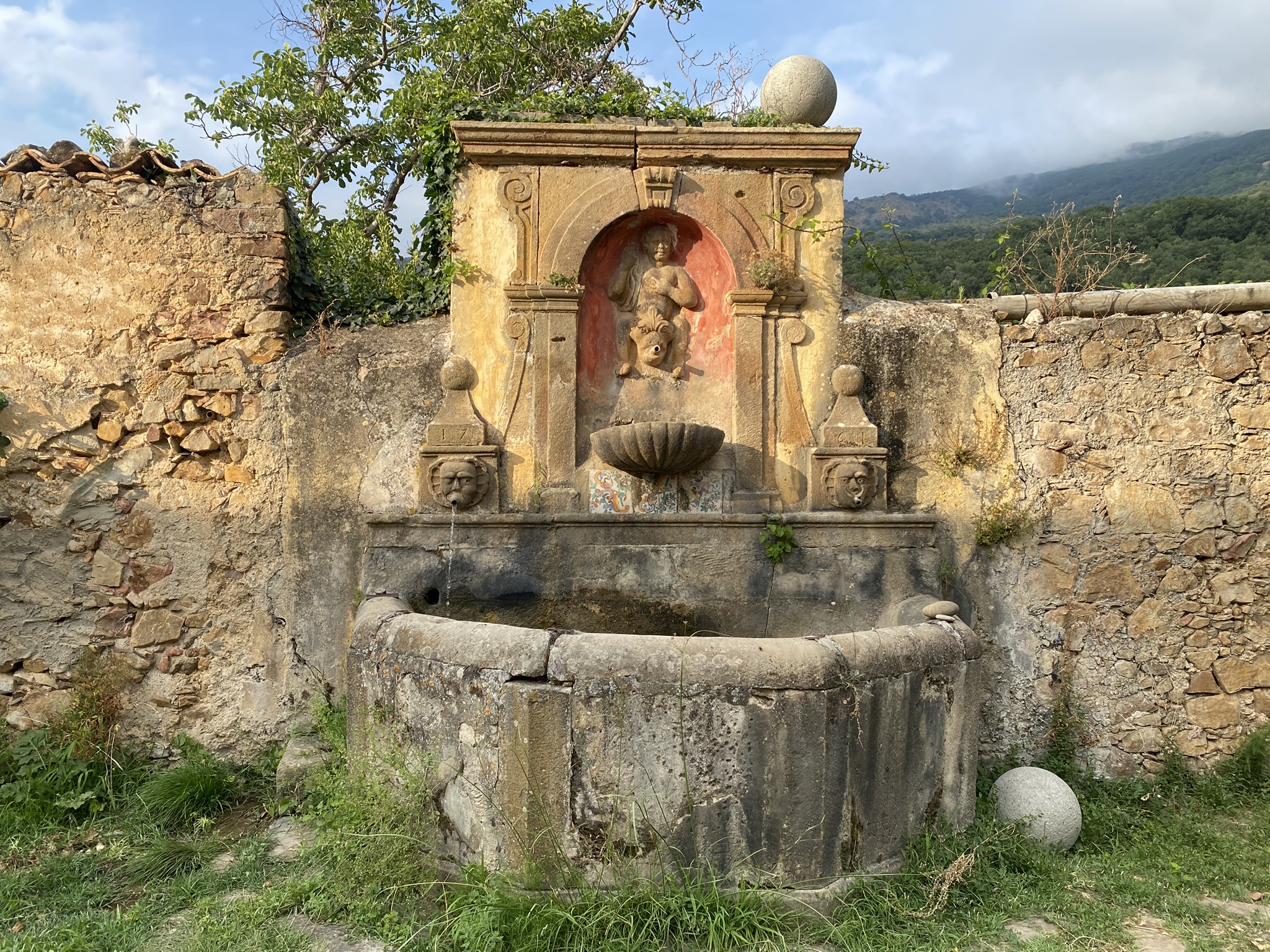
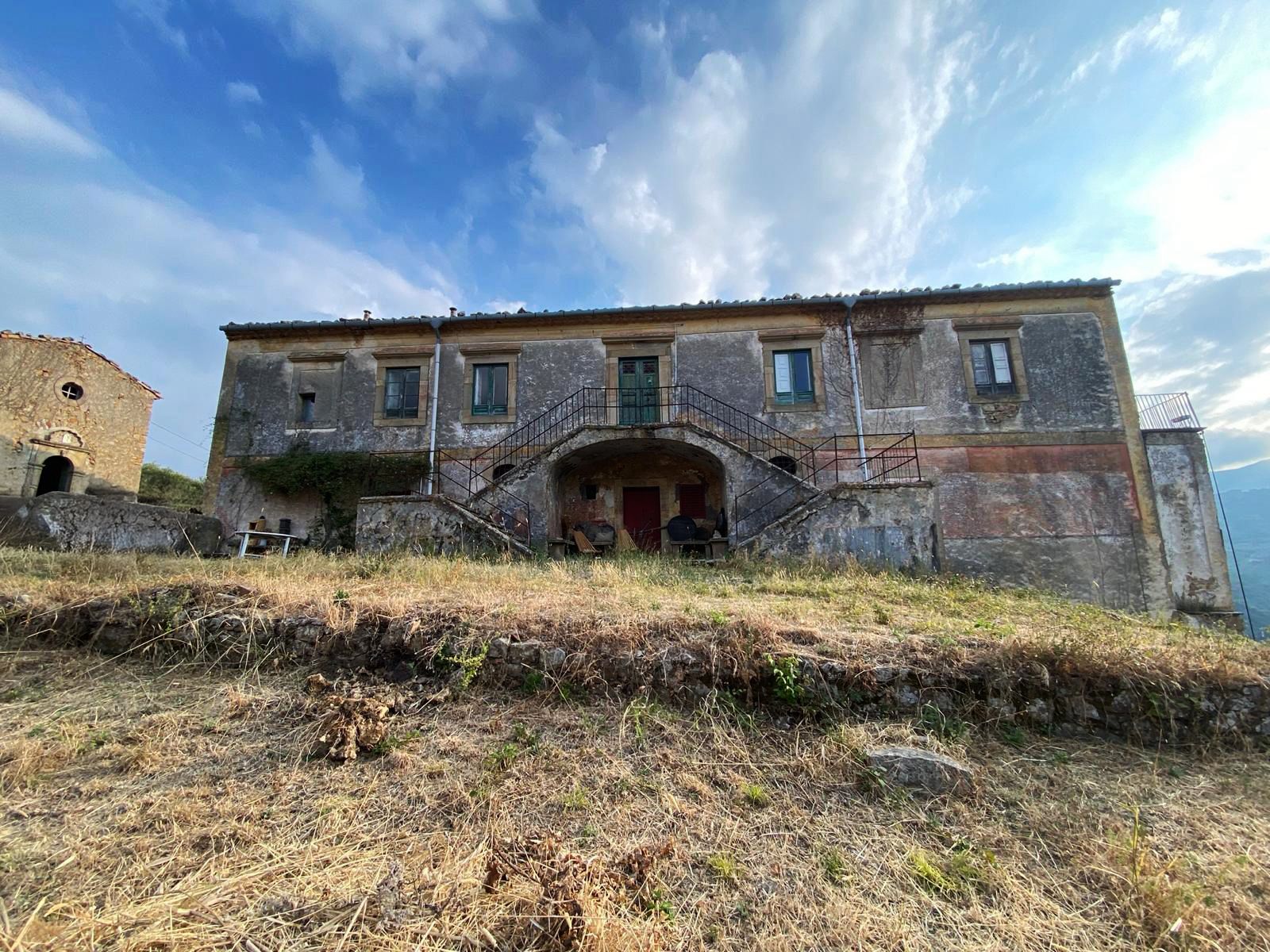
I find some doors open that lead to the warehouses where an ancient olive mill is still visible, with its enormous stone millstone and press operated by pack animals. Electricity would arrive very late in these parts, but the old owners, heirs of the Natoli-Giaconia family, had in the meantime circumvented the problem by purchasing a modern system located in another building and powered by a generator. The mill remained in operation until the 1960s, becoming the reference point for the surrounding area for olive milling.
Next to the building is the completely unadorned rural church, dated 1783, with a small altar and majolica floor at the back.
Martin Décleve and Valérie Verdinne: From the Pandemic to Their Dream
The chirping of the cicadas is momentarily interrupted by the arrival of a car: it's Martin, who greets me with a warm smile, which I promptly return.
We begin sipping a cool aperitif on the terrace, which accompanies our pleasant chat, during which Martin tells me about himself and what brought him here from Belgium.
"It's a project that started a long time ago: I taught Latin and Greek for twenty-two years, and my wife Valérie inherited a family pharmacy, but we both had a desire to dedicate ourselves to art. So, at a certain point, I left teaching to pursue photography and cinematography professionally, and, with Valérie, we restored a house in Brussels together. During the pandemic, despite the restrictions, we started traveling in Italy until we arrived in Sicily, where we encountered this territory that immediately fascinated us."
"Valérie and I," Martin continues, "always thought about buying a property with special characteristics, one that would tell a story by itself, and we thought that in this area, sooner or later, we would find it. We didn't entrust our search to real estate agencies, but rather to word-of-mouth. So, thanks to common acquaintances, we were put in touch with the old owners, and after a while, our search concluded."
After the pandemic, Martin and Valérie bought the property from the Parlato-Martorana family and immediately began cleaning and recovering the grounds, but not the building itself. This was a deliberate choice. "For now, we are focusing on cleaning the eighteen-hectare land," Martin continues, "but for me, it's a real spectacle to recover it little by little. Every day is a new discovery, and that's beautiful! The goal is to clean about four hectares and leave the rest as woodland. The house will only be renovated when we fully understand which direction to take. We are looking for a model to apply, but the common ones don't satisfy us, so we will wait as long as necessary. We plan, however, to create a model that combines culture with agriculture."
The DDT Project is Born: Contemporary Art Marries History
"Two years ago, Valérie, some friends, and I spent our first summer in this place. Outside, it was still a jungle, but we all perceived the charm that emanated from the whole: peace, beauty, the land, history. In the meantime, we abandoned the idea of creating a farm holiday resort and simply dedicating ourselves to hospitality and catering. So we took a break, and now we are looking for a deeper, more spiritual purpose, creating a reality where our desire for creation can be shared. I can't imagine a day without creativity, without the desire to create, and with Valérie, we believe we can develop a life model that transmits happiness."
"We then shared the idea of setting up an exhibition now, leaving and presenting the building as we found it, using the many rooms to host the creations."
As stated in the press release, the DDT project uses the message found on the wall as the title of this initiative, but above all, it elevates it to a keyword full of expectations, in a residence that, in fact, at the moment, offers nothing regal but a rare, expansive sense of cathartic peace. Unlike A and G, the two unknown individuals who signed the graffiti with only their initials after a short stay more than one hundred and twenty years ago, Declève and Verdinne are well aware that in the long term of their stay, the undertaking will consist of "giving time back to the temporary."
Next to the entrance door, on the wall, some dates traced in red paint can be read: above, 1761, that of the foundation of the structure; on both sides of the door, dates ranging from 1948 to 1967 refer to the period of DDT spraying against malaria. Over the centuries mentioned, the place has undergone numerous transformations. But it is undoubtedly during the mid-century following the ban on the insecticide, at the end of the 1970s, that the most radical metamorphosis occurred: the conclusion of agricultural activity, the abandonment of the land, and the use of the main building, left for more than thirty years, as an occasional holiday home. The DDT years were those of the "great acceleration." Beyond the illusory desire to distance this recent past, the misappropriation of the acronym expresses the new owners' desire to make this place a place of agriculture and culture, a space where time can be given back to the provisional.
DDT project – Before leaving this royal residence
Artists: Régis Baudy, Sébastien Bonin, Alessandro Costanzo, Étienne Courtois, Martin Declève, Myriam El Haïk, Laurent Friob, Anna Guillot, Sebastiano Leta, Renee Marcus Janssen, Emmanuel Piron, Rawakari, Agostino Rocco, Alfredo Sciuto.
DDT project: Martin Declève & Valérie Verdinne Dimora del temporaneo, Mistretta, Contrada Romei, Sicily, Italy 16.08—14.09.2025 Opening: Saturday 16—Sunday 17 August
(1) Romei, crocevia dei pellegrini. Nella Faillaci, Il Centro storico-giugno 2003