In Vino Salus in Lascari: a Glass of Wine Tells the Story of the Madonie
Wine, territory, the Targa Florio and music in the evocative setting of La Pirrera
Riccardo Zingone 17/09/2026 0
Wine as a product of the land, but also as a way to discover and tell the story of a territory. This was the central theme of “In Vino Salus”, the event held on 16 September at La Pirrera Urban Park in Lascari, promoted by the Municipality of Lascari and organised by the Pro Loco of Lascari, the Strada dei Vini e dei Sapori delle Madonie sul percorso della Targa Florio and ONAV Enna – Nicosia branch.
The choice of La Pirrera added a special atmosphere to the evening. Lascari’s ancient tuff quarry, characterised by cavities and tunnels created by quarrying activities and now restored as an urban, cultural and environmental space, is itself a testament to the relationship between people and the land. It was therefore a particularly fitting setting in which to talk about wine, landscape and identity.
The Pro Loco of Lascari, which has long been committed to promoting the local community, its traditions and cultural and tourism initiatives, contributed to organising an event that attracted a large audience and transformed the tasting into an opportunity to discover the territory.
Four wineries, four expressions of the land
Four wineries took centre stage during the tasting.
Abbazia Santa Anastasia, based in Castelbuono and committed to organic and biodynamic production, includes among its labels Passomaggio, Montenero and Litra, the latter made entirely from Cabernet Sauvignon.
Castellucci Miano, from Valledolmo, cultivates mountain vineyards located between 700 and 1,050 metres above sea level, with a particular focus on Catarratto and Perricone. Its wines include Miano, Shiarà, Perric.One, Maravita, Miano Brut and Nero d’Avola.
Tasca d’Almerita – Tenuta Regaleali, in the Sclafani Bagni area, is one of Sicily’s historic wine estates. Among the estate’s iconic labels are Rosso del Conte, originating from the San Lucio vineyard, and Nozze d’Oro, a white wine made from Inzolia and Sauvignon Tasca.
Finally, Tenuta San Giaime, in Gangi, represents the high-altitude viticulture of the Madonie. Its wines include S’23 Syrah, G’25 Grillo, N’22 Pinot Noir, M’22 Nerello Mascalese and P’22 Perricone, as well as Maqarat.
Four wineries with different histories, altitudes, grape varieties and production philosophies, united by their ability to express in every glass the distinctive character of the places where their vines are grown.
Salvatore Burrafato: tasting wine means tasting the territory
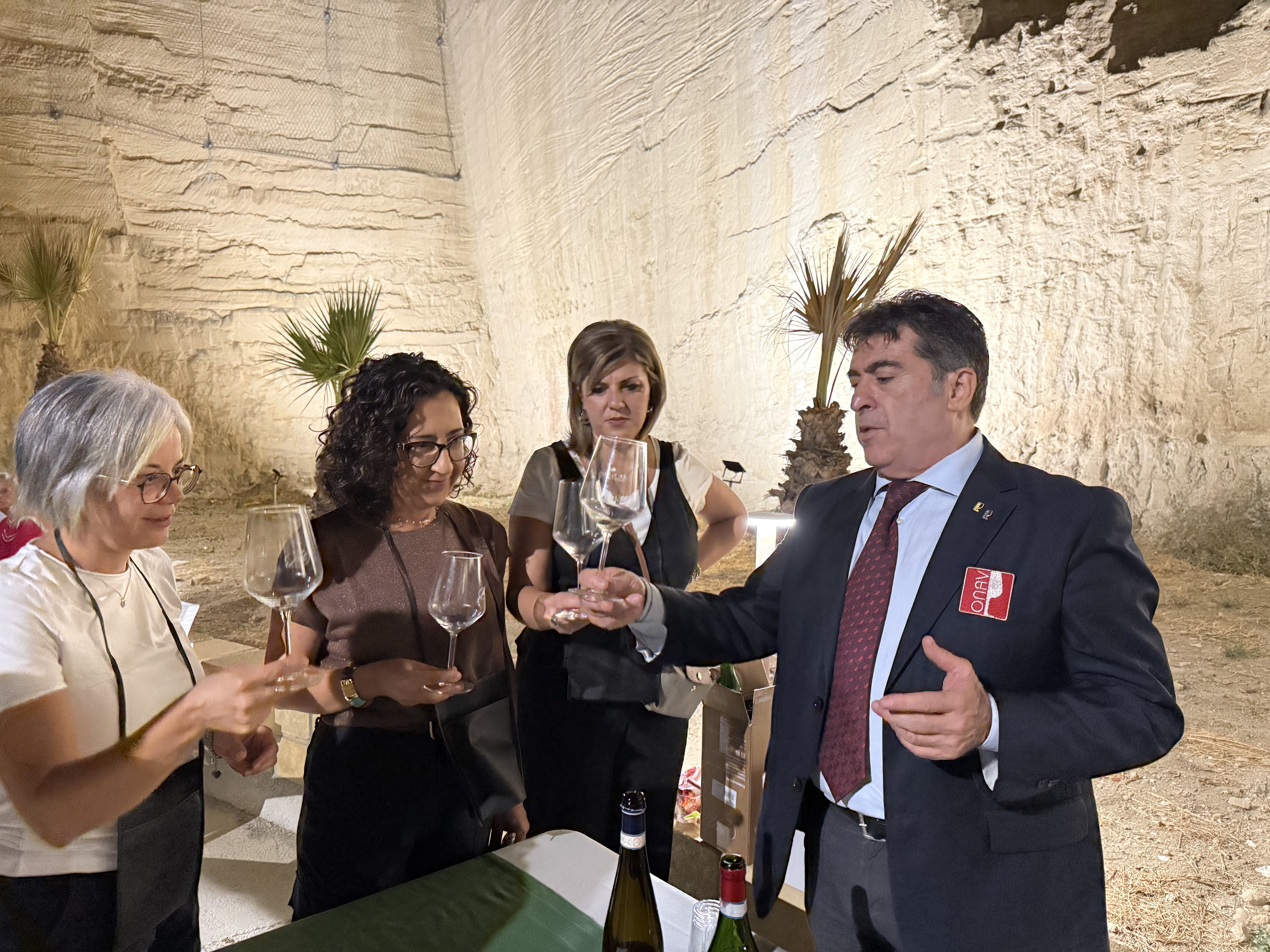
The event was opened by Salvatore Burrafato, an ONAV wine taster, who guided the audience through a journey of conscious wine tasting.
At the heart of his presentation was the inseparable connection between wine and terroir. Every wine is born from the interaction of four fundamental elements: soil, climate and microclimate, grape variety and human intervention.
Wine, therefore, is not simply the result of a production process; it is an expression of the place where it originates. Change the soil, altitude, exposure or microclimate, and the same grape variety can reveal a completely different character.
It was from this perspective that Burrafato invited the audience to experience the evening’s tasting: through those wines, in a sense, we were tasting the Madonie themselves.
The Wine Route begins again: from product to journey
This same vision was at the heart of the contribution by Salvatore Cicco, from Tenuta San Giaime and President of the Strada dei Vini e dei Sapori delle Madonie sul percorso della Targa Florio.
With a history spanning around twenty years, the association resumed its activities in 2026 after a period of inactivity. This new beginning has the potential to be significant not only for the wine sector, but for the entire tourism system of the Madonie.
A Wine Route reaches its full potential when it succeeds in transforming a collection of outstanding local products into a genuine travel itinerary.
A winery then becomes one stop on a broader journey encompassing restaurants, traditional products, accommodation, landscapes, cultural heritage, local towns and communities. A wine tasting can be combined with a walk through the vineyards, a meeting with the producer, a lunch inspired by local cuisine or the discovery of places that are usually outside the traditional tourist routes.
And this is where the Targa Florio can become an extraordinary distinguishing feature.
The roads on which one of the world’s most celebrated motor races was born can become the narrative thread through which travellers explore the Madonie and encounter their wines, flavours and communities.
No longer three separate elements, but one story: Wine, Food and the Targa Florio.
The revival of the Wine Route can therefore help create a distinctive and marketable tourism offer, connecting wine producers, restaurateurs, accommodation providers, tourism operators and local authorities. Above all, it can encourage visitors to travel through the territory rather than limiting their experience to a single destination.
This perspective is particularly relevant for inland areas, where experiential tourism can encourage longer stays and help distribute visitor flows towards places and businesses that would otherwise struggle to reach tourism markets independently.
From the Madonie towards Nicosia and the western Nebrodi
This vision can also extend beyond the geographical boundaries of the Madonie themselves.
The collaboration with ONAV Enna – Nicosia branch points towards an interesting connection with Sicily’s inland areas and the western Nebrodi.
Nicosia can serve as a natural bridge between territories that share mountain landscapes, agricultural and food traditions, local heritage and a common need to develop an integrated tourism offer.
After all, administrative boundaries matter little to travellers. What matters are the experiences, the roads they travel and the stories a territory is able to tell.
A greeting from Totò Riolo and the music of the Quartetto Florio
One particularly enjoyable moment came with a phone call from Totò Riolo, the racing driver from Cerda with deep ties to the Targa Florio and an eleven-time winner of the historic competition, who was unable to attend the evening in person.
At the end of his greeting, Riolo good-naturedly reminded the audience to drink in moderation, inevitably bringing a smile to those who were, at that very moment, taking part in an event dedicated to discovering and appreciating wine.
The evening was accompanied by the music of the Quartetto Florio, a Sicilian string quartet whose repertoire ranges from classical music to contemporary interpretations of famous pop and rock songs.
In Vino Salus showed how a wine tasting can become something more: an opportunity to tell the story of a landscape, its products and its history.
And perhaps this is precisely the challenge facing the renewed Strada dei Vini e dei Sapori delle Madonie sul percorso della Targa Florio: to ensure that behind every bottle visitors discover a place — and that, once they have discovered that place, they feel inspired to set out on a journey to experience it for themselves.
Because behind every wine there is a territory.
And that evening, at La Pirrera in Lascari, the Madonie were in the glass.
You may also like...
Riccardo Zingone 14/06/2026
Agri Med Europe: the Nebrodi embrace the Mediterranean
The Spirit of Agri Med Europe 2026 and the Value of Hospitality
A magnificent celebration of the people, welcoming its guests in the best possible way. Ultimately, this is what Agri Med Europe 2026 was all about: a massive, choral embrace through which an entire territory chose to showcase itself to the world by sharing the very best it has to offer. Welcoming the international delegation brought with it several values and meanings that go far beyond a standard moment of institutional courtesy. Indeed, it reinforced the principle that the Mediterranean must be interpreted as a place of encounter rather than conflict; that territorial boundaries must be overcome through cohesion among peoples; and that the word guest—a term that in antiquity simultaneously encompassed the concepts of "the host" and "the hosted"—proved that the principle of hospitality was an undeniable aspect of human dignity. These are tough concepts to swallow in times when there is endless talk of barriers, border defenses, and "racial" or ethnic distinctions. Thanks to the political activity of the D-MED Political Committee in strengthening dialogue among Mediterranean countries, and to the hospitality offered by a small corner of the magnificent Nebrodi mountain range, an exceptional example of welcome, intercultural dialogue, and mutual friendship was put on display.
The Conference: "What is Needed from Europe to Support Agricultural Producers"
Agri Med Europe was therefore conceived and realized to grant visibility to the Nebrodi region through its cultural and traditional values. The agri-food and ceramic sectors channel themselves perfectly into this path, serving as a genuine expression of local identity. The exhibitors' stands (nineteen dedicated to Nebrodi agri-food products and six to ceramics from Santo Stefano), carefully positioned along the charming side streets lining the long Via Vittorio Veneto in Santo Stefano di Camastra, revealed themselves to visitors only as they passed by, making it impossible to spot them from a distance. This image, which the organizers perhaps unintentionally offered to the public, serves as a metaphor for the hard, silent, and sometimes invisible work behind companies that struggle daily to keep their businesses running amidst restrictions, bureaucracy, and often incomprehensible regulations.
Institutional Dialogue with MEP Antoci and Territorial Marketing
These were the key themes that emerged from the dialogue between producers and Europe during the meeting held between the exhibitors present at Agri Med Europe and MEP Antoci, at the foot of the Mother Church of the city of ceramics. The numerous speeches that followed reinforced the need for mutual collaboration between operators and institutions, based on and supported by a careful territorial marketing plan, as the only way to provide concrete answers to the various sectors that form the social and economic backbone of the territory. These insights and requests were promptly welcomed by the MEP who, as a supporter and practitioner of the "politics of doing," made himself available to listen closely to the producers. Together, they are working on a comprehensive territorial organization project that takes into account the needs, critical issues, and enormous potential that sometimes struggle to express themselves due to a lack of up-to-date marketing strategies.
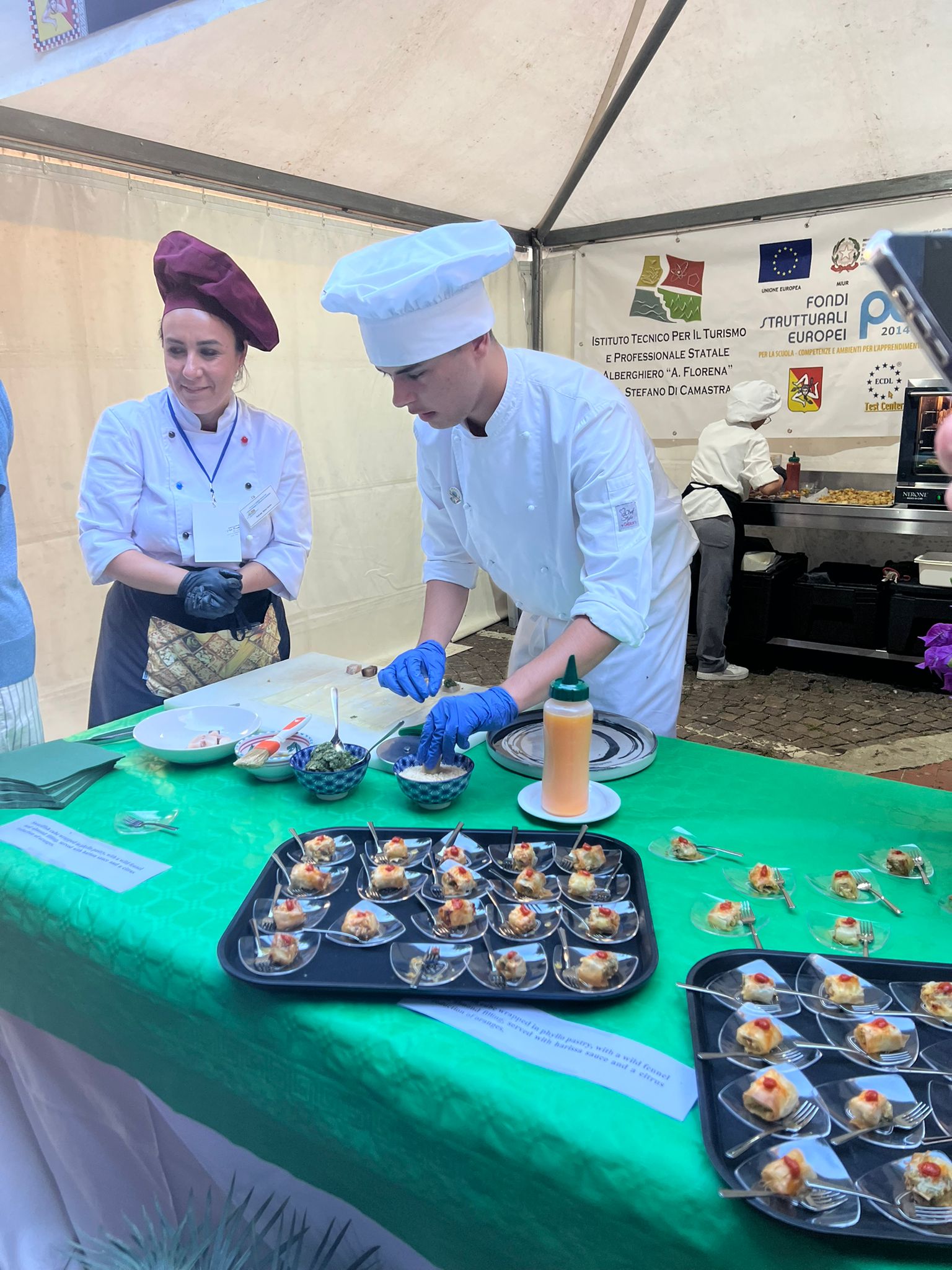
Equally interesting and meaningful was the participation of the I.I.S. "A. Manzoni" of Mistretta, represented by the Hospitality School based in Santo Stefano di Camastra. The synergy sparked between this institution and the Slow Food Nebrodi operators—which materialized in the presentation of several iconic local dishes—further reinforced the concept that agri-food traditions must not only be preserved but, above all, passed down from generation to generation, recognizing food as a powerful expression of identity.
The Official Inauguration and Folk Traditions in Celebration
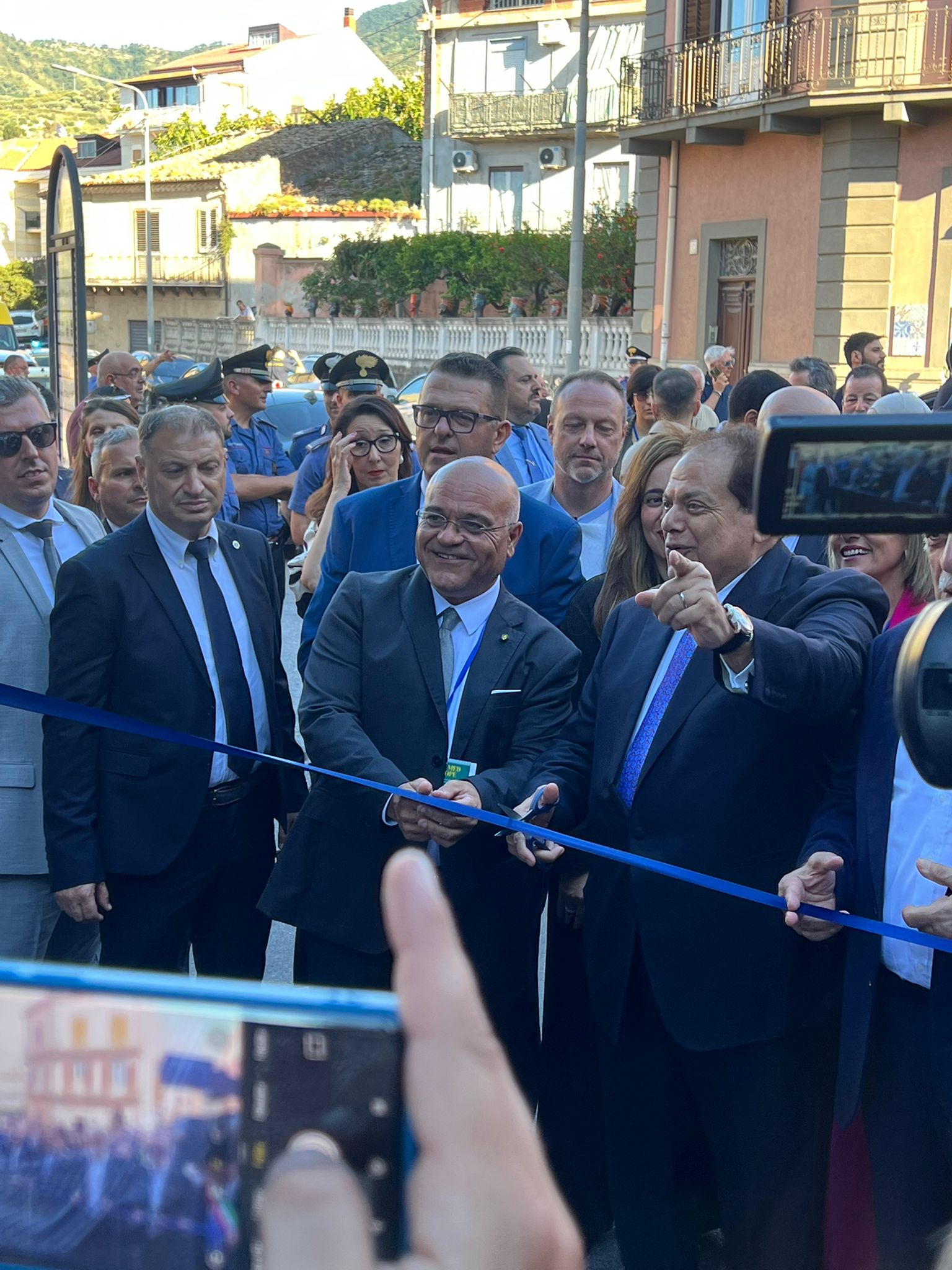
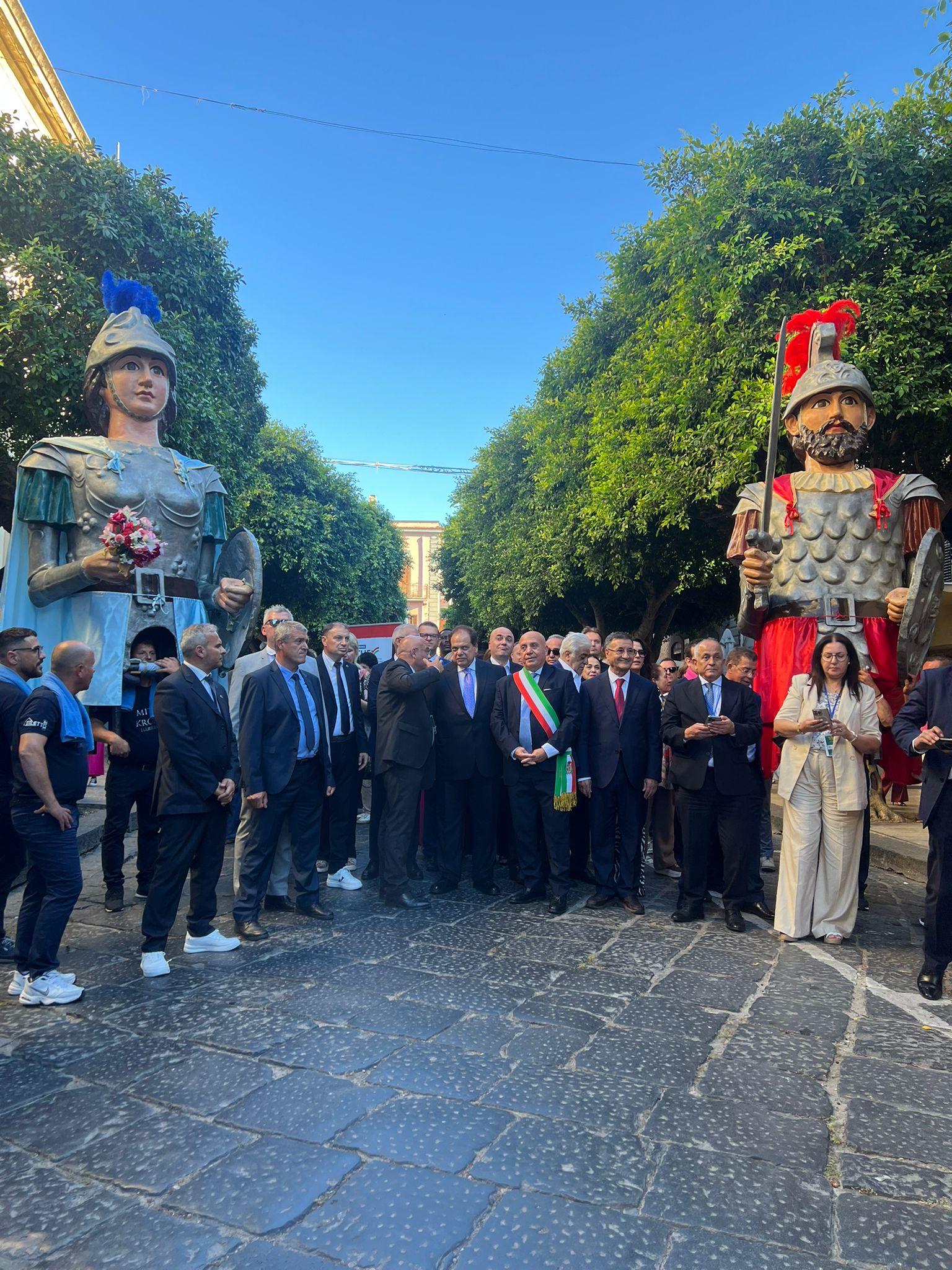
The strong emotional charge following the ribbon-cutting ceremony—performed by the President of the Parliamentary Assembly of the Union, the Egyptian Mohamed M. Abou El Enein, and the President of the D-MED Political Committee, MEP Giuseppe Antoci—was palpable throughout the entire event. It accompanied the delegation and the audience until the manifestation closed late in the evening. This emotion quickly turned into amazement at the very first musical notes, which accompanied the striking dances of the Giants of Mistretta through the streets of Santo Stefano. These iconic symbols of the Nebrodi city's identity were followed by festive performances from the Amastra folk group, the Santa Cecilia Musical Association of Santo Stefano di Camastra, the cheerleaders of the I.C. Tusa-Mistretta, and the large, colorful group of the Jews of San Fratello (Giudei di San Fratello). This wonder was immediately evident from the vast number of smartphones held high in the air, eager to capture unique images to show back home or to share instantly via social media livestreams, thus providing an exceptional and deeply meaningful promotional opportunity for the territory.
The Final Message: The Strategic Centrality of the Nebrodi and Sicily
Drawing from these sensations, impressions, and the resulting economic development prospects for the region, Agri Med Europe delivers a powerful message: the Nebrodi area, bolstered by its biodiversity and authenticity, can and must play a strategic role in the economic and social development of the territory, thanks to the recognized and reinforced central role of Sicily within Mediterranean economic and trade routes.
Exhibitors in Attendance:
Terre audaci, Gelateria artigianale Giovanni Alferi, Acquafico Garden, Dei Casabona, Il vecchio carro, Il Melograno, Il Cavaliere, La dispensa del massaro, Caseificio Albereto, Dolci tentazioni, Condotta Slow Food Nebrodi, A.Fioriglio, 24 Baroni, Li paternosci, Casaleni Natural Bio, Villa Colonna, Ceramiche Serravale, Nadal, Le Malagioie, Le terrecotte del soleil, Nino Ferrigno, Zolea Art & Design.
Riccardo Zingone 18/08/2026
Maria Messina Literary Prize in Mistretta
The Maria Messina Prize is a major cultural initiative promoted by Associazione Progetto Mistretta. The Maria Messina Literary Prize was first held in 2004 and is dedicated to the writer Maria Messina.
Maria Messina, one of Sicily’s most important women writers, was born in Palermo in 1887. In 1903 her father, a school inspector, was transferred to Mistretta, where the family lived until 1909. During those formative years she began writing stories inspired by the town. They were published in 1911 and contributed to two notable collections, Pettini fini and Piccoli gorghi. She later wrote novels and books for young readers and died in Pistoia in 1944.
One hundred years after leaving Mistretta, Maria Messina symbolically returned to the town she loved. In 2009 her remains were laid to rest beside her mother in Mistretta’s monumental cemetery. The initiative, promoted by Associazione Progetto Mistretta with the municipality and local community, also led to a street near the Church of San Giuseppe being named after her.
To honour the author—who corresponded with Giovanni Verga—Associazione Progetto Mistretta has organised the literary prize since 2004. The nineteenth edition was scheduled for 5 October in the reception hall of the Circolo Unione.
The prize is open to writers, young authors and students who find their chosen form of expression in writing. Over the years it has honoured prominent Sicilian, Italian and international writers and cultural figures, with participants and award recipients from the United States, Germany, Tunisia and Spain.
The event also recognises associations, local initiatives and individuals whose work contributes to storytelling, the arts and cultural life. This edition includes a posthumous award dedicated to a distinguished painter from Palermo.
Halaesa Nebrodi 08/08/2024
Saint Sebastian’s Feast in Mistretta – 18 August
Feast of Saint Sebastian in Mistretta: Religious Celebrations and Traditions
The city of Mistretta is preparing to honor Saint Sebastian the Martyr, Patron Saint of the Nebrodi community, with a rich program of events involving both faithful and visitors.
Start of Celebrations – August 11th
The festivities begin on August 11th with the solemn ringing of bells, marking the official opening of the celebrations in honor of Saint Sebastian. The evening will continue with a performance by the I.C. Tommaso Aversa Orchestra in "Note di Notte" (Night Notes), an unmissable musical event.
Triduum and Traditional Activities – August 15th-17th
From August 15th to 17th, the Triduum of Saint Sebastian will be characterized by numerous religious and cultural events. On August 16th, the XVIII edition of the Saint Sebastian Foot Race Trophy, a traditional sporting event, will take place. On August 17th, music and entertainment will enliven the city with the Euterpe Band, the Majorettes of Capizzi, the children of Hakuna Matata, and a performance by Alessandro Gandolfo.
Culminating Day – August 18th
August 18th is the most anticipated day: the Holy Mass will precede the Solemn Procession of the Simulacrum of Saint Sebastian and his relics, which will pass through the streets of Mistretta. To conclude, a fireworks display will illuminate the sky, followed by a show by Pippo Palmieri, directly from Radio 105's Zoo.
Concert by Danilo Sacco – August 19th
On August 19th, Danilo Sacco will hold a concert that promises to engage and captivate the audience. The evening will conclude with the drawing of raffle prizes, adding a further touch of excitement to the festivities.
Closing of Celebrations – August 25th
The festivities in honor of Saint Sebastian will officially conclude on the following Sunday, August 25th, with the traditional solemn ringing of bells that will bid farewell to participants and close this week of celebrations.