Federico Massimo Ceschin and the Visitor Economy: A New Paradigm for Italy’s Inner Areas
From tourist flows to the value that remains: Federico Massimo Ceschin explains how to measure visitors’ contribution to communities and territories.
Riccardo Zingone 23/10/2026 0
Visitor Economy: beyond the numbers, towards a new paradigm for territorial development
Interview with Federico Massimo Ceschin, author of Visitor Economy, Volumes 1 and 2
For years, we have measured tourism’s success through arrivals, overnight stays and the growth of accommodation capacity. But are these indicators enough to describe the value tourism generates for a territory—and, above all, how much of that value remains in the host communities?
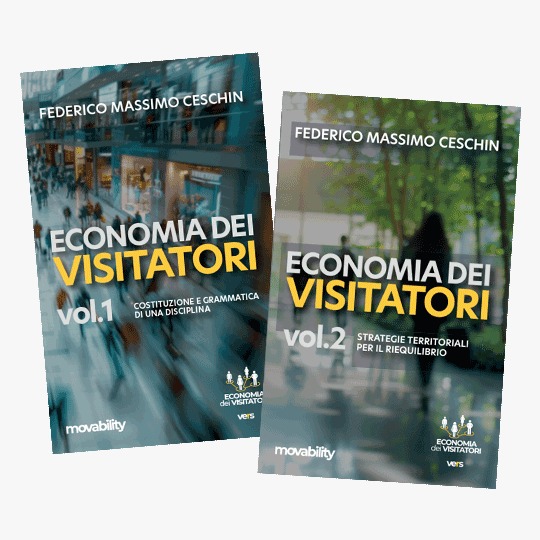
This question is the starting point for our conversation with Federico Massimo Ceschin, author of the two volumes of Visitor Economy (Movability, 2024 and 2026). He works to promote new models of territorial development and is president of SIMTUR, the professional ecosystem for regenerative tourism, of which I am a member.
His proposal forms part of the wider transformation of tourism from sustainability to regeneration. Sustainability seeks to reduce the negative impacts of tourism; regeneration aims to create tangible benefits for the environment, local economies and resident communities. The goal, therefore, is not simply to use fewer resources, but to help restore and enhance them.
This approach is also reflected in European policy through the European Agenda for Tourism 2030. In Italy, the Strategic Tourism Plan 2023–2027 incorporates several principles of sustainability and innovation. The question of how to apply them in practice—and, above all, how to measure the benefits they produce in local areas—remains open.
Ceschin’s two books, aimed at public administrators, tourism businesses, local development professionals and communities, offer a way of thinking that moves beyond the traditional focus on tourists and considers the full range of economic, social and cultural relationships generated by visitors.
This perspective is particularly relevant to the GMT™ Halaesa Nebrodi, whose work is rooted in the idea of a Culture of Hospitality, as developed by Andrea Succi, the creator of Territori e Italianità. Its values are repeatedly reflected in Ceschin’s work.
Reading the two volumes led us to the seven questions we put to Ceschin: a conversation about the meaning of the Visitor Economy, the role of communities, the limits of current measurement systems and the practical possibilities for changing the paradigm.
Riccardo Zingone — Territorial Tourism Coordinator (CTT™), GMT™ Halaesa Nebrodi
The Visitor Economy: a paradigm shift
Tourism is measured by what comes in: arrivals, overnight stays and turnover. The Visitor Economy is measured by what remains and is renewed. Value is what a territory retains and puts to work over time; a flow is only a receipt. A territory can set records for overnight stays—statistics will register this as success—while it loses residents, neighbourhood shops and even the people who care for its places and communities.
The paradigm shift has three steps. First, we look at everyone who passes through a place, including people who do not stay overnight. Second, we measure the value retained alongside visitor flows. Third, we give someone the responsibility for keeping the territory alive—a responsibility that no public body currently holds explicitly. Destination Management Organisations (DMOs) have a promotional mandate, municipalities have an administrative one, and regions allocate resources. This new perspective is intended for administrators, businesses and professionals who plan destinations, but above all for communities: without their recognition, no strategy can truly be effective.
From tourist to visitor: beyond definitions
International institutions define a visitor as someone who travels outside their usual environment for less than a year, for any reason: a tourist if they stay overnight, a same-day visitor if they do not. We propose one further step: a visitor is anyone who adds value through their time in a place, or simply by passing through it.
Every tourist is a visitor, but not every visitor is a tourist. Same-day visitors, commuters, pilgrims, students living away from home, business travellers, digital nomads, second-home owners, people returning to their places of origin and city users all behave as consumers: they spend money, use services and draw on resources, yet conventional tourism accounts may not record them at all.
The practical consequence is that waste services, transport, healthcare and parking are planned for a population that appears only partly in the data. “Tourist” and “visitor” are two ways of looking at the same person. The first is a flow from which to extract value; the second is someone who can give value back. To see the people missing from the data, I use the footprint method: we infer the invisible population from the traces it leaves, such as waste and homes not used as primary residences.
The territorial steward: the community as protagonist
A steward is someone whose work keeps the territory functioning as an economy: the farmer who maintains the terraces, the shepherd who tends the pastures, the winegrower, the fisher who knows the routes. The steward is a structural node in the constellation of value, yet receives the least. Platforms earn money from visitors who come to see that landscape, while the steward is left out of the transaction. The terraces begin to slide, and the children see no reason to return.
There is a deeper dimension to the economy. The steward stays because they recognise something of their own history in what they maintain: they belong to a community of heritage, in the sense used by the Faro Convention. A system that pays them without recognising them turns them into a service provider.
I see the role of the CTT, which you hold within GMT Halaesa Nebrodi, as part of this same family, with a specific function. Territorial stewardship has three parts: safeguarding, caring and connecting. The steward safeguards. The person coordinating the territory connects: they make stewards visible to one another and to institutions, and bring their remuneration—through payments for ecosystem services or stewardship contracts—to the tables where decisions are made. A community becomes welcoming when the people who keep it going are recognised and paid for that work. The visitor comes afterwards.
Beyond records: what is tourism really worth?
Records tell us how much is moving; they tell us little about how much remains. In 2024, Istat recorded 139.6 million arrivals and 466.2 million overnight stays in accommodation establishments, with international guests accounting for more than half of demand. These were all-time highs, and Italy ranked second in Europe after Spain. The global picture is different. Until the 1980s, Italy ranked first for international arrivals; today it is fifth. It will soon fall to seventh, perhaps eighth place: we are growing in absolute terms but continue to lose market share.
The value that remains can be measured with three tools. Leakage and the local multiplier show how much spending flows out and how many times the rest circulates locally. The “K-country coefficient” measures the state’s presence in essential services. VERI looks at five dimensions: retained economic value, community vitality, ecological integrity, cultural richness and capacity for the future. It tracks them over time, comparing a territory with itself.
Carrying capacity, in turn, sets limits across three dimensions: ecological, infrastructural and social. The total is multiplied by “K-country”, because where the state is absent every threshold collapses. The Doxey Index signals when residents’ welcome turns into irritation. For this reason, carrying capacity must be read as a threshold specific to each territory, not as one number that applies everywhere.
VERA, VERI and VERS: from theory to experimentation
They are three steps on the same scale: an alert, an index and a strategy, with a Master Plan to put them into practice.
VERA is operational. It uses only open national data that are complete at municipal level: ISPRA municipal waste, housing from the 2021 Census and Istat accommodation capacity. It requires nothing from the municipality. It places each municipality in one of four quadrants (extractive tourism, depopulation, full residential use, occasional residential use) and flags when a result is unstable. It is a compass, not a ranking, built around indicators that pass the “councillor’s test”: data the municipality already has or that are publicly available. The open issue is the share of each euro retained at municipal scale, which public data alone cannot establish.
For Halaesa Nebrodi, I would start as follows:
- Apply VERA to the seven municipalities as one territory, without ranking them against one another. In small municipalities, tourism movement is often suppressed in published data because it falls below the reporting threshold; that is why VERA uses footprints.
- Present the findings to all seven mayors together, at a joint steering group. Individual meetings could be read as a ranking.
- Begin with a “zero phase” in five steps: name the problem, map the actual stakeholders, check whether relationships have sufficient critical mass, set non-negotiable limits, and choose the lightest workable structure.
- Walk with the people who actually safeguard the territory and ask three questions: What do you safeguard that no one else can safeguard in your place? What would happen if you stopped doing this? What would you like people to recognise about your role, socially and economically?
From VERA, the work can move to VERI—if a municipality asks for it—to define the resource-consumption index, which can then inform a VERS, or regeneration strategy.
How can we manage and guide change towards 2040?
We must stop counting only arrivals and overnight stays. We need new parameters and indicators that can measure retained value. This is the gap that the Visitor Economy proposes to fill.
The risk for Italy is to create a new promotional mandate for DMOs in law just as the model from which they originated—the United Kingdom—is undergoing a major rethink. Here is what I would do now:
- Write legislation around the DMO’s mandate before settling on its name: tools and evaluation must match, or the organisation will optimise its indicators and lose sight of the strategy.
- Establish uniform levels and accreditation criteria to avoid twenty different models.
- Include an indicator of retained value alongside visitor flows in every accreditation system.
- Give small municipalities an intermunicipal task force with technical, coordinating and institutional liaison responsibilities.
- Train destination managers as a professional role; it is currently absent from Italy’s training frameworks at every level.
The Visitor Economy and the GMT™ Model
The affinities are clear: territorial identity as a starting point, communities becoming welcoming through a participatory process, and a focus on small municipalities. Andrea Succi and I worked together on the book The New Role of DMOs.
I see a division of responsibilities. GMT builds a welcoming community from within. The Visitor Economy adds three things: a clear-eyed assessment of the starting point (VERA), a way to measure over time whether the process is regenerative (VERI), and a governance framework for municipalities that lack staff to act alone (a community pact and an intermunicipal task force).
Doubling the number of international travellers by 2040 will not automatically benefit small municipalities. Projections also point to greater concentration: a few urban and coastal hubs, and platforms retaining a growing share of the margin. By 2040, places with a strong identity and shared governance will be able to attract a more widely distributed flow of visitors and retain its value. Others will see more visitors in territories increasingly emptied of the people who care for them. That is why I see the two approaches as distinct but coordinated: GMT as the engine of identity and hospitality; the Visitor Economy as a system-wide measure and a set of rules for distributing value across the different sectors of the local economy.
You may also like...
Halaesa Nebrodi 18/10/2025
Mistretta, Capital of Popular Memory: Folklore Becomes National Heritage
Mistretta Awarded the Prestigious National Title of “City of Folklore 2025”
Mistretta has been awarded the prestigious national title of **“City of Folklore 2025”**, a recognition granted by the **Italian Federation of Popular Traditions (FITP)**. The honor highlights the universal value of the town’s **demo-ethno-anthropological heritage**, passed down with passion through centuries of popular and religious traditions.
This honor, unanimously approved by the FITP, originated from a proposal by the **Municipal Council** and directly reflects the efforts of both the **local administration** and cultural associations in preserving, promoting, and passing on Mistretta’s ethnographic heritage to future generations **Motivation and Significance of the Recognition**
In its official statement, the FITP emphasized how **Mistretta**, already renowned as the birthplace of anthropologist **Giuseppe Cocchiara**, stands out for its ability to preserve and pass on rituals that find their fullest expression in events such as **Holy Week**, the **Feast of Saint Sebastian**, the **Dance of the Giants**, and many other devotional re-enactments. These rituals blend the sacred and the profane in a **civil language of identity and belonging**.
A key role in the transmission of these values is played by the **Centro Studi Amastra**, a leading institution in researching and promoting local traditions. The award also pays tribute to the community spirit and passion with which the people of Mistretta protect their memory, cohesion, and identity—bringing Italy’s folkloric heritage to life.
---
### **The Ceremony and Folklore Evening**
The award was celebrated during an **official ceremony held at the “Falcone e Borsellino” Cine-Theatre**, which was filled to capacity. The event included an **extraordinary session of the Municipal Council**, during which the title was formally ratified.
Following the official proceedings, the theatre transformed into a vibrant stage of **music, color, and tradition**. Participants included students from **Mistretta and Tusa**, the Palermo-based folk singing group **Le Matriosche**, the Catania storyteller **Luigi Pino**, and the **Centro Studi Amastra**, which has long played a leading role in local cultural promotion.
*(Source: Quadrochiaro.it)*
Riccardo Zingone 12/07/2025
Tourism in Inner Areas: A Value to Be Given Meaning
Inner Areas: Italy's True Beating Heart
For several decades, the so-called Inner Areas have been a priority on the political agenda and, by reflection, in the economic and social strategies of Italian regions. Long identified as the Achilles' heel of the national nervous system, Inner Areas, geographically distant from large urban agglomerations and peripheral in terms of access to essential services like healthcare, education, and mobility, nonetheless continue to host a significant portion of the Italian population. According to a recent 2024
We're talking about the Italy of villages rich in history, culture, and traditions, populated by people with ancient wisdom, heirs to an extraordinary tangible and intangible culture. These places boast countless beauties to discover among pristine mountains and seas, local stone constructions and red tiled roofs, interwoven with ancient alleys and small squares where time seems to stand still. These villages are special places, designed to live in symbiosis with their surrounding environment. They are extraordinary settings that offer a genuine identity, where every step forward seems to powerfully transport us back in time, in a virtuous loop that appears endless. At the same time, however, these places are symbols of fragility: often marginal and marginalized, far from essential services, and thus subjected to the relentless scythe of depopulation and economic and social impoverishment.
This phenomenon has not spared the western edge of the Nebrodi area, comprising the Municipalities of Mistretta, Santo Stefano di Camastra, Reitano, Castel di Lucio, Pettineo, Tusa, and Motta d’Affermo, as evidenced by data collected between 2002 and 2022 (ISTAT). The unforgiving numbers tell us that this area experienced an average population decrease of -17%, with peaks of -30%, in terms of resident population.
It's well-known that, precisely because of the characteristics described above, Inner Areas have, in recent years, attracted the interest of numerous tourists drawn to slow, immersive, and experiential tourism. This has created the conditions for a regenerative process within the villages themselves, but given the fragile context in which it could develop, it requires careful and targeted governance and organizational structuring.
The Culture of Hospitality: A Prerequisite for Tourism
"The culture of Hospitality does not coincide with tourism, but it is its prerequisite." (Andrea Succi)
In this direction, an innovative organizational model has developed over the years, already successfully applied in various regions of Italy, and which, in 2024, landed in Sicily. We are talking about the GMT™ (Territorial Marketing Group) format and the new figure of the CTT™ (Territorial Tourism Coordinator). The project stems from the decennial work of Dr. Andrea Succi, founder of the
The GMT™ Halaesa Nebrodi and Regional Applicability of the Model
Based on these premises, in January 2024, the GMT™ Halaesa Nebrodi was launched in Sicily, coordinated by me in my role as CTT™. It encompasses the Municipalities of Santo Stefano di Camastra, Reitano, Mistretta, Tusa, Pettineo, Castel di Lucio, and Motta d’Affermo.
Nestled between the western edge of the Nebrodi Park and the eastern edge of the Madonie, the Halaesa-Nebrodi area represents a unique blend of history, art, traditions, culture, geo- and biodiversity, in an exceptional symbiosis of sea, hills, and mountains. Undoubtedly, Halaesa Nebrodi has all the credentials to become an authentic Tourist Destination. With this objective, thanks to the synergy with over twenty economic operators, it is approaching a role and identity in professional tourism as a bearer and guardian of immense tangible and intangible knowledge, exemplified by the Ceramics of Santo Stefano di Camastra, the millennia-old history of Mistretta, the archaeological excavations of Halaesa Arconidea, the secular olive trees of Pettineo, the traditions linked to rural civilization, agri-food products, and the
Cultural Regeneration as a Starting Point
The seven Municipalities are thus represented in their singularities and specificities but integrated into a broader and shared context, in the conviction that cohesion and interaction between Municipalities can lay the foundations for the cultural, social, and economic regeneration of individual realities. Halaesa-Nebrodi, thanks to the pristine beauty of its characteristic villages and their inhabitants, has long been a tourist destination. However, in our project, we intend to propose this special place as an authentic Tourist Destination, coining and strengthening a brand that arises, almost naturally, from the synergy between different communities, and which, precisely in diversity, demonstrates its strength and conveys its great attractiveness. According to this model, local identities ("campanili") should not be demolished but reinforced and instead pooled into a broader and shared project. Communities and administrators are therefore called to dialogue, interaction, and sharing to chart a new regenerative path that can counteract the social and economic decline that we all have a duty to oppose, each with our own role and expertise.
The Role of Institutions
With a view to developing a shared project, the seven administrators were asked to approve an Action Plan that can lay solid foundations for territorial tourism planning through valuable and indispensable work in study, training, awareness-raising, consultancy, and support for operators and public administration. The GMT™ model, by its nature replicable and scalable, was presented in Nicosia during an interesting workshop, sparking the interest of administrators, economic operators, associations, and the
Riccardo Zingone 17/04/2025
Amastra per leggere in Mistretta from April 23rd to May 23rd Sicily
Mistretta is solidifying its position as a significant cultural hub in the Nebrodi region. Following its successful inaugural edition in 2024, the event titled "Amastra che legge in festa 2025, the Festival of Books and Reading" is making its return.
With the patronage of the Municipality of Mistretta and the collaboration of numerous local associations and educational institutions, the event promises to strengthen the deep cultural sensitivity already demonstrated by the Amastratina community towards books and culture. This characteristic allowed Mistretta to compete as a finalist for Italian Book Capital 2025 through a project of great cultural, social, and identifying value, stemming from its recognition as a "Reading City" in 2024 by Cepell.
The book, therefore, takes center stage for an entire month rich in exhibitions, presentations, readings, educational workshops, and debates. Thus, within the framework of "May of Books," it will be interpreted not only as a tool for cultural dissemination but also for social cohesion and growth.
The festivities kick off on April 23rd with the exhibition "M'illumino leggendo" (I Light Up Reading), part of World Book and Copyright Day, organized by the I.C. Tusa-Mistretta at the Municipal Library. This will be followed by an interesting dialogue, entirely in Mistrettese dialect, titled "Mistretta, Identity and Narrative," featuring Corriere della Sera journalist Alessio Ribaudo and Vito Ribaudo, Human Resources Director of RCS. In the following days, various authors will be met, including Margherita Neri, Sara Magnoli, Tea Ranno, Mariangela Biffarella, Francesca Maccani, Mattia Corrente, and Massimiliano Città.
The initiative benefits from the valuable collaboration of the Pro Loco Mistretta APS Association, the Tusa-Mistretta Comprehensive Institute, the IIS A. Manzoni Mistretta, the Libreria Capitolo 18, the Hakuna Matata Association, the La Valle delle cascate di Mistretta Association, and the FIDAPA section of Mistretta.