The Hyblaean Mountains meet the Nebrodi Mountains in an interesting gastronomic journey
Lorenzo and Giuseppe: two chefs from Palazzolo Acreide searching for the flavours of the Nebrodi Mountains
Riccardo Zingone 04/10/2025 0
Halaesa Nebrodi: A Journey of Flavors Between the Hyblaean and Nebrodi Mountains
The main objective of the CTT™ Territorial Tourism Coordinator of Halaesa Nebrodi is the promotion of the territory as an expression of a specific identity. Its "genius loci" is characterized by the diversity offered by the individual municipalities, which benefit from a catalytic and multiplying effect when put in synergy. Along the path started a few years ago, I've met and crossed paths with countless people: operators, administrators, travelers. But the story I want to tell you today has some very interesting nuances that, in my opinion, deserve a closer look, directly involving three of our Operators.
The Taste of Excellence: The Meeting with Èstro Restaurant
Giuseppe Luparelli (chef) and Lorenzo Sorrentino (pastry chef) are the owners of Èstro Restaurant (link: [Èstro Restaurant] ) in Palazzolo Acreide (SR). Their cuisine, while firmly rooted in the valuable gastronomy of the Hyblaean Mountains, is pleasantly open to regional, national, and international influences. Seasonality is a fundamental element of their philosophy, while innovation and the reinterpretation of dishes in a contemporary key represent the added value the team offers its customers.
In this continuous journey of enrichment and constant improvement, Giuseppe and Lorenzo are looking for new ideas to embellish their dishes and, why not, invent new ones. Driven by this passion, they decided to contact Halaesa Nebrodi in search of flavors and gastronomic traditions from our territory.
The request was simple: to visit some local businesses within a few days in search of local products of excellence and, if possible, unique ones.
Organizing the Mini-Tour
We collaborated on how to organize and optimize the mini-tour, given the long distance between Halaesa Nebrodi and the Hyblaean region and the relatively little time available. We drew up a three-stage program: visits to two farms and lunch in Mistretta.
Stop 1: The Provola D.O.P. from Azienda Antonio Fioriglio
The first farm visited by Giuseppe and Lorenzo is located in the territory of Mistretta, leaving the SS 117 a few kilometers after cresting Serra Merio (1093 mt). This is the Azienda agricola zootecnica Antonio Fioriglio (link: [Azienda agricola zootecnica Antonio Fioriglio]), known everywhere for the famous Provola dei Nebrodi D.O.P. Here, immersed in 100 hectares of green and uncontaminated pastures of the Nebrodi Park (Zone B), the company stands strong with a long family history dating back to 1890, now in its fifth generation.
Welcoming Giuseppe and Lorenzo was Biagio, Antonio's son, who, along with his brother Paolo, dedicates himself with love and dedication to the family business. The tasting was "challenging": in addition to the inevitable Provola dei Nebrodi D.O.P., Biagio offered a rich platter consisting of other seasoned and unseasoned cow's milk cheeses, warm fresh ricotta that had just been produced, and, the icing on the cake, the prized baked ricotta (ricotta infornata), queen of several island dishes, including the famous Pasta alla Norma.
Stop 2: Authentic Flavors at Turismo Rurale SESIMA
As it was nearly lunchtime, our Giuseppe and Lorenzo left the Fioriglio farm amid the ringing bells of the cows and headed towards Turismo rurale SESIMA (link: [Turismo rurale SESIMA]).
The ancient farmhouse is located along the SS 117, right at the entrance to Mistretta when arriving from the hinterland. The view you can enjoy once you arrive is truly breathtaking: the gaze wanders across the pastures of the great valley up to the peaks of the Nebrodi Mountains, made green by ancient and lush forests.
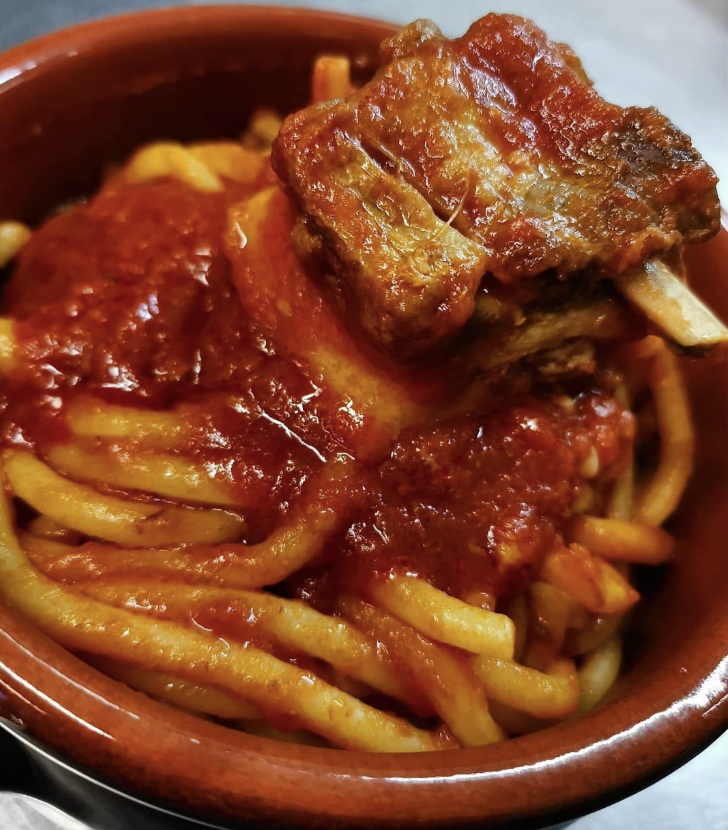
Here, the two chefs met Simona Di Gregorio, the hostess and kitchen manager. Despite the generous earlier snack, there was still room for fresh bucatini with Nebrodi Black Pig and a sumptuous Nebrodi Florentine Steak (Fiorentina) to share. An excellent way to come into contact with the superb local meats.
Stop 3: Innovation and Tradition with Messinese Goat Salami
The journey of our chef friends continued towards Santo Stefano di Camastra (link: [Santo Stefano di Camastra]) intrigued by the news regarding the recent launch of a new product: the Messinese Goat Salami (Salame di Capra messinese), which we recently covered in this article.
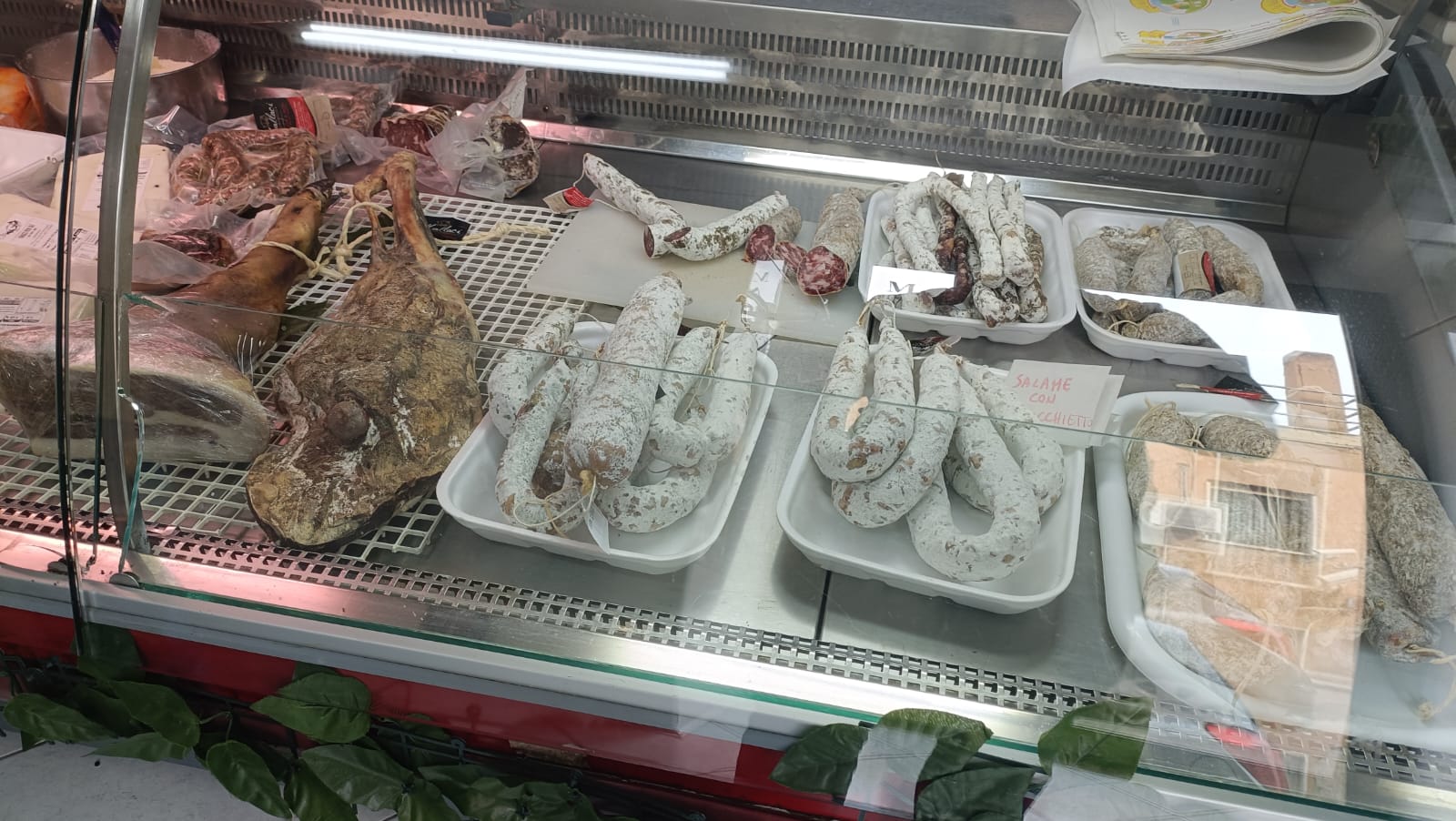
The Azienda di Antonino Mallaci Bocchio (link: [Azienda di Antonino Mallaci Bocchio]) , located in the territory of Cerami, close to that of Mistretta, officially introduced an innovative product to the market that, in reality, has solid roots in the past and tradition of the Nebrodi. The sales point, La dispensa del Massaro (link: [La dispensa del Massaro]) , is located right in the City of Ceramics, and here Giuseppe and Lorenzo were welcomed by Antonino, who presented them, in addition to the Goat Salami and the Nebrodi Black Pig Salami, a series of dairy products derived from goat's milk.
Mission Accomplished
This is the story of an exceptional day dedicated to promoting the territory, but what matters most are the impressions collected by Giuseppe and Lorenzo:
"Today we took a journey to discover the authentic Sicily, one made of ancient flavors and traditions. The first farm, that of Antonio, Biagio, and Paolo, showed us products of great value but also people with big hearts. Leaving the SS 117 and following the navigator, we got lost, but thanks to Antonio's helpfulness, we managed to reach the farm (Editor's Note: unless you have a 4x4, it's advisable to arrive at the gates of Mistretta and head towards Contrada Fontana Murata). The welcome was excellent, as were all the products we tasted, especially the baked ricotta which we found special and different from what we use in our area. Its delicate taste pleasantly struck us.
Likewise, lunch at SESIMA met our expectations and stimulated new gastronomic ideas, just as learning about the goat products from Antonino's farm in Santo Stefano di Camastra convinced us to experiment and propose something new to our guests.
Our menu, already rich in excellent products, will be enhanced by a fresh pasta dish with goat ragù, dusted with baked ricotta."
So, mission accomplished! The Hyblaean Mountains marry the Nebrodi Mountains through a unique dish that unites two fascinating worlds of our splendid Island.

You may also like...
Halaesa Nebrodi 16/02/2026
Mistretta's Pasta Reale ignites an interesting comparison on social media
In Mistretta, attention has once again turned to one of the most identity-defining symbols of the local confectionery tradition: Pasta Reale. In recent days, Dr. Riccardo Zingone formally submitted to the Mayor of the Municipality of Mistretta, Dr. Sebastiano Sanzarello, a request to initiate the procedure for the inclusion of “Pasta Reale di Mistretta” in the regional list of Traditional Agri-Food Products (PAT), pursuant to the current regulations.
An identity heritage of the community
Pasta Reale represents one of the most authentic expressions of the gastronomic culture of Mistretta and the Nebrodi area. Prepared with finely ground almonds and handcrafted until a compact, oily dough is obtained, it forms the base of numerous specialties: from baked or raw pasta reale to the Easter lamb, up to the renowned marzipan fruit.
The production process, handed down from generation to generation, preserves knowledge and techniques that vary from producer to producer, making each interpretation unique while respecting a shared tradition. It is precisely this family-based and artisanal transmission—never fully revealing its “secrets”—that contributes to preserving its exclusivity and cultural value.
The request to initiate the procedure
In his official petition, Zingone emphasizes that Pasta Reale di Mistretta is not merely a confectionery product, but an identity element deeply rooted in the collective memory of the community. The request aims to safeguard its original characteristics in a context where, in recent years, the product has undergone reinterpretations and commercialization in other municipalities as well, with the risk of altering its distinctive features and recognizability.
Inclusion in the regional PAT list would represent an initial and significant institutional recognition, intended to formalize the historical and production characteristics of the dessert through a shared production specification and adequate technical-historical documentation.
Zingone has also declared his willingness to actively collaborate in preparing the necessary materials, involving scholars, artisans, and sector operators.
Support and the precedent of the De.Co. Regulation
The proposal immediately sparked discussion on social media (https://www.facebook.com/share/p/17zq3r5MFh/?mibextid=wwXIfr), gathering support from citizens and institutional representatives. Among the most significant contributions was that of Dr. Salvatore Antoci, who recalled that as early as 2012, in his role as City Councilor, he had proposed the adoption of the De.Co. Regulation (Municipal Designation of Origin) for typical products, with specific reference precisely to Pasta Reale.
The regulation, approved by the Municipal Executive in 2014 and again in 2015, and subsequently by the City Council, also provided for an identifying logo depicting Pasta Reale. However, although it was published on the official notice board, it was never concretely implemented and has effectively remained unenforced.
Antoci now proposes to resume from that very De.Co. Regulation, pending the procedure for recognition as a Traditional Agri-Food Product, thus equipping the Municipality with an immediate tool for protection and enhancement.
A shared path for the future
The perspective outlined by Zingone also looks beyond PAT recognition, envisioning in the future a path toward PGI status, which would require even more structured work in terms of production specifications, traceability, and promotion.
Beyond the technical aspects, the debate that has developed in the city highlights a significant fact: Pasta Reale is not merely a dessert, but a collective symbol around which an entire community identifies itself. The protection of traditional productions, in fact, concerns not only the economy or territorial marketing, but also the safeguarding of history, identity, and sense of belonging.
The matter now passes to the Municipal Administration, called upon to assess the initiation of the procedure and to coordinate work that will require historical research, dialogue with producers, and the drafting of production specifications capable of combining authenticity with openness to the future. The discussion is open, but one point appears shared: Pasta Reale di Mistretta deserves official recognition that affirms its value and preserves its most authentic soul.
(from Quadrochiaro.it, Anna Saitta, 14/02/2026)
Riccardo Zingone 20/07/2025
People of Halaesa Nebrodi: Martin Declève and his Royal Residence
The Story of Romei
The Contrada Romei, located in the territory of Mistretta, is one of the most iconic rural areas in the heart of the Nebrodi region. It's believed that, according to the descriptions by Silius Italicus and Polybius, the ancient city of Noma once stood here, and that the name "Romei" derives directly from the ancient inhabitants of this Greco-Roman city, the Nomei.
Nestled along the eastern slope that winds up towards Contrada Zupardo, near the Serravalle torrent, the former Romei feudal estate was renowned for its abundant production of grapes, citrus fruits, olive oil, and various other fruits. At one time, mulberries were also extensively cultivated here, their leaves serving as food for silkworms. The fertility of the land, combined with the mild climate, encouraged the inhabitants of Mistretta to settle here, as evidenced by the numerous ancient farmhouses still present.
After 1684, the Fief was assigned to Santo Stefano di Camastra but, following various legal disputes, a portion of it returned to the ownership of the Municipality of Mistretta. This led to a sell-off, and many lands were ceded to powerful families such as the Allegra, Natoli, Salamone, Armao, and Aversa, who built prestigious villas. Over time, this district became so populous that it warranted the presence of a detachment of Mistretta's elementary school, housed in a dedicated building where dozens of children were educated. This continued until the 1960s, as recounted and documented by Nella Faillaci, a passionate local history researcher and former head of the Municipal Historical Archive of Mistretta.
Today, the former Romei Fief is experiencing a new season: many of the old families no longer exist, but several estates have gained new life thanks to the interest of numerous new owners who have decided to make these places their home. It's from this interesting regenerative impulse that our story begins.
Palazzo Natoli-Giaconia: A Pearl Set Among Ancient Oaks and Olive Trees
I arrive for my appointment with Martin a few minutes before the scheduled time. He had informed me of a delay shortly before but had given me permission to enter the property. As soon as I step out of the car, which had until then protected me from the summer heat and isolated me from sounds and smells, I'm literally enveloped by the beauty of the place and the incessant chirping of cicadas. There are experiences that transport us back in time, and immediately I feel immersed in an unexpected situation that deserves respect: the ancient farmhouse hosting me, the "Regale dimora" (Royal Residence, as described in pencil on a wall by a guest), radiates extraordinary energy.
I feel like a guest in a place of great sanctity and, for this reason, I move on tiptoe. Even the ancient stone pavement deserves respect, and I tread upon it with circumspection.
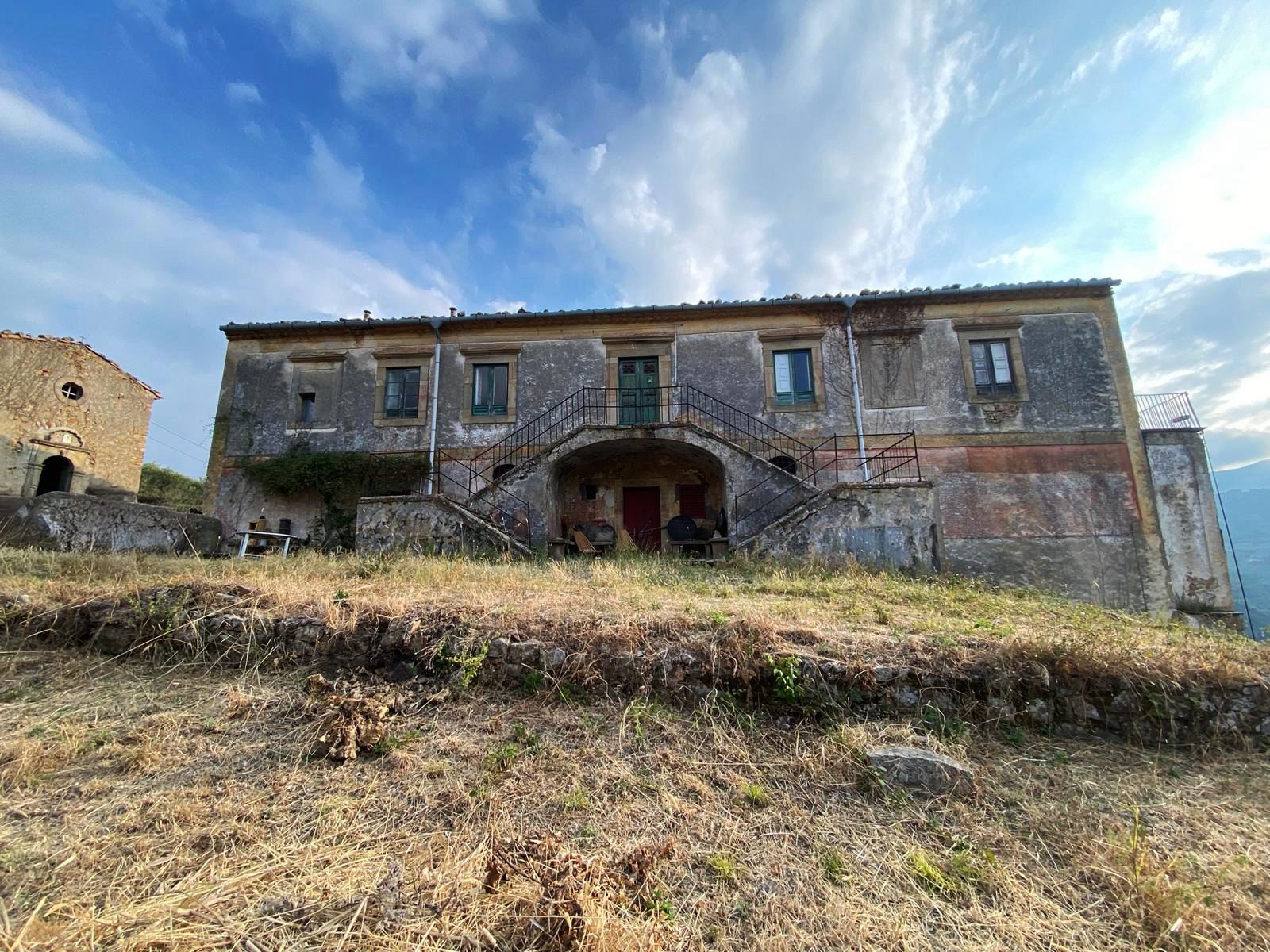
While waiting for Martin's arrival, I wander around the courtyard of the imposing, yet well-integrated, historic residence, surrounded by ancient olive trees and dense woodland. Peering here and there, my attention is immediately captured by a spectacular fountain with the date 1761 carved into it. Water flows, and there is life. The central sculpted figure is nestled in a stone niche that still retains red decorations, a characteristic also visible along the main two-story facade, which features a spectacular double-ramp staircase leading to the upper floor. Indeed, I notice how the red with which the ground floor walls were painted is still visible on the facade, which, together with yellow and green, must have given the building a particularly elegant and classical appearance. After all, we are in the midst of Neoclassicism, and the echo of the archaeological excavations of Pompeii and Herculaneum evidently reached here too, leaving its mark on this building. 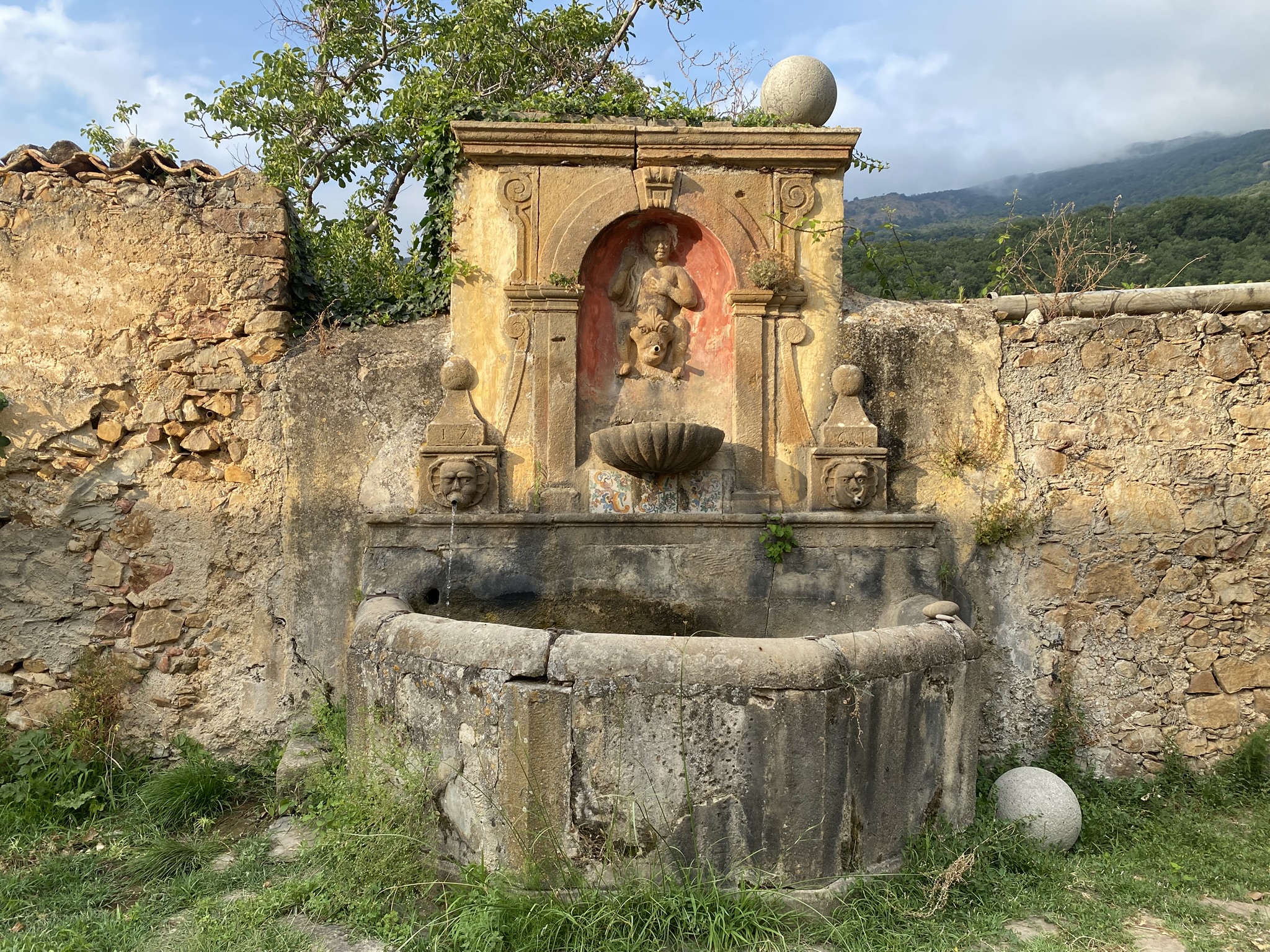
I find some doors open that lead to the warehouses where an ancient olive mill is still visible, with its enormous stone millstone and press operated by pack animals. Electricity would arrive very late in these parts, but the old owners, heirs of the Natoli-Giaconia family, had in the meantime circumvented the problem by purchasing a modern system located in another building and powered by a generator. The mill remained in operation until the 1960s, becoming the reference point for the surrounding area for olive milling.
Next to the building is the completely unadorned rural church, dated 1783, with a small altar and majolica floor at the back.
Martin Décleve and Valérie Verdinne: From the Pandemic to Their Dream
The chirping of the cicadas is momentarily interrupted by the arrival of a car: it's Martin, who greets me with a warm smile, which I promptly return.
We begin sipping a cool aperitif on the terrace, which accompanies our pleasant chat, during which Martin tells me about himself and what brought him here from Belgium.
"It's a project that started a long time ago: I taught Latin and Greek for twenty-two years, and my wife Valérie inherited a family pharmacy, but we both had a desire to dedicate ourselves to art. So, at a certain point, I left teaching to pursue photography and cinematography professionally, and, with Valérie, we restored a house in Brussels together. During the pandemic, despite the restrictions, we started traveling in Italy until we arrived in Sicily, where we encountered this territory that immediately fascinated us."
"Valérie and I," Martin continues, "always thought about buying a property with special characteristics, one that would tell a story by itself, and we thought that in this area, sooner or later, we would find it. We didn't entrust our search to real estate agencies, but rather to word-of-mouth. So, thanks to common acquaintances, we were put in touch with the old owners, and after a while, our search concluded."
After the pandemic, Martin and Valérie bought the property from the Parlato-Martorana family and immediately began cleaning and recovering the grounds, but not the building itself. This was a deliberate choice. "For now, we are focusing on cleaning the eighteen-hectare land," Martin continues, "but for me, it's a real spectacle to recover it little by little. Every day is a new discovery, and that's beautiful! The goal is to clean about four hectares and leave the rest as woodland. The house will only be renovated when we fully understand which direction to take. We are looking for a model to apply, but the common ones don't satisfy us, so we will wait as long as necessary. We plan, however, to create a model that combines culture with agriculture."
The DDT Project is Born: Contemporary Art Marries History
"Two years ago, Valérie, some friends, and I spent our first summer in this place. Outside, it was still a jungle, but we all perceived the charm that emanated from the whole: peace, beauty, the land, history. In the meantime, we abandoned the idea of creating a farm holiday resort and simply dedicating ourselves to hospitality and catering. So we took a break, and now we are looking for a deeper, more spiritual purpose, creating a reality where our desire for creation can be shared. I can't imagine a day without creativity, without the desire to create, and with Valérie, we believe we can develop a life model that transmits happiness."
"We then shared the idea of setting up an exhibition now, leaving and presenting the building as we found it, using the many rooms to host the creations."
As stated in the press release, the DDT project uses the message found on the wall as the title of this initiative, but above all, it elevates it to a keyword full of expectations, in a residence that, in fact, at the moment, offers nothing regal but a rare, expansive sense of cathartic peace. Unlike A and G, the two unknown individuals who signed the graffiti with only their initials after a short stay more than one hundred and twenty years ago, Declève and Verdinne are well aware that in the long term of their stay, the undertaking will consist of "giving time back to the temporary."
Next to the entrance door, on the wall, some dates traced in red paint can be read: above, 1761, that of the foundation of the structure; on both sides of the door, dates ranging from 1948 to 1967 refer to the period of DDT spraying against malaria. Over the centuries mentioned, the place has undergone numerous transformations. But it is undoubtedly during the mid-century following the ban on the insecticide, at the end of the 1970s, that the most radical metamorphosis occurred: the conclusion of agricultural activity, the abandonment of the land, and the use of the main building, left for more than thirty years, as an occasional holiday home. The DDT years were those of the "great acceleration." Beyond the illusory desire to distance this recent past, the misappropriation of the acronym expresses the new owners' desire to make this place a place of agriculture and culture, a space where time can be given back to the provisional.
DDT project – Before leaving this royal residence
Artists: Régis Baudy, Sébastien Bonin, Alessandro Costanzo, Étienne Courtois, Martin Declève, Myriam El Haïk, Laurent Friob, Anna Guillot, Sebastiano Leta, Renee Marcus Janssen, Emmanuel Piron, Rawakari, Agostino Rocco, Alfredo Sciuto.
DDT project: Martin Declève & Valérie Verdinne Dimora del temporaneo, Mistretta, Contrada Romei, Sicily, Italy 16.08—14.09.2025 Opening: Saturday 16—Sunday 17 August
(1) Romei, crocevia dei pellegrini. Nella Faillaci, Il Centro storico-giugno 2003
Halaesa Nebrodi 25/06/2025
Euterpe Fest in Motta d'Affermo
Even the town of Motta d'Affermo is preparing to present its own event within the scope of the project "Costa e Valli Alesine: an itinerary for rediscovering the villages of Castel di Lucio, Motta d'Affermo, and Pettineo."
This is the Euterpe Fest, an interesting musical proposal that will take place on June 26th at Palazzo Minneci. The Muse of Music, Euterpe, will thus enter the restored halls of the historic residence to offer attendees some captivating musical moments, entrusted to distinguished artists who will propose a varied program ranging from folk traditions to jazz, concluding with a brass ensemble performance.
Here is the program with a brief description of the artists.
TOTÒ FUNDARÒ The storyteller from Alcamo in songs, tales, and stories of Sicilian popular tradition, in the poems of farmer poets. Totò Fundarò is an authentic heir to the tradition of Sicilian storytellers, a figure who combines peasant wisdom with narrative and musical mastery. He not only interprets and tells stories of Sicilian popular tradition but enriches them with his guitar, often with an expressiveness that recalls that of virtuous Spanish guitarists. His art is deeply rooted in rural life and the culture of the land, so much so that documentaries such as "I Villani" by Daniele De Michele and "Pi Amuri o pi Raggia" by Fabrizio Raggi have been dedicated to him. Fundarò is also a cultivator of ancient Sicilian grains and a member of Simenza, embodying an indissoluble link between art and his land.
ALESSANDRO PRESTI and Sicilian Quartet Alessandro Presti is a talented trumpeter, arranger, and composer of Motta d'Affermo origin, considered one of the most refined and sought-after of the new generation of Italian jazz. Trained between Italy (Messina, Siena Jazz) and the United States (New York), he has developed a style that combines the rigor of hard bop with an attention to the more contemporary idioms of jazz. He has collaborated with prominent figures such as Roberto Gatto and Francesco Cafiso, and boasts important recognitions such as the "Chicco Bettinardi" Award and the Top Jazz 2022 award in the Italian New Talent category. His music is deeply linked to Sicilian roots, with a strong attachment to the land and the local band tradition, which influenced his approach to the trumpet from childhood thanks to his father, a bandmaster.
GRUPPO OTTONI STEFANESE Director M. Massimo Fiorella. The Gruppo Ottoni Stefanese is an ensemble that promotes brass chamber music, offering a captivating repertoire that ranges from classical to lyrical, from jazz to pop, with original pieces, transcriptions, and arrangements. These brass groups, often composed of musicians with a solid classical and band background, are known for their ability to create unique and powerful atmospheres through the warm and resonant sound of brass wind instruments. The band tradition is very strong in Sicily, and the Gruppo Ottoni Stefanese carries on this heritage with professionalism and passion, under the direction of Maestro Massimo Fiorella.