Euterpe Fest in Motta d'Affermo
Folk traditions, jazz, and a brass ensemble in Motta d'Affermo to celebrate Euterpe, the Muse of Music.
Halaesa Nebrodi 25/06/2025 0
Even the town of Motta d'Affermo is preparing to present its own event within the scope of the project "Costa e Valli Alesine: an itinerary for rediscovering the villages of Castel di Lucio, Motta d'Affermo, and Pettineo."
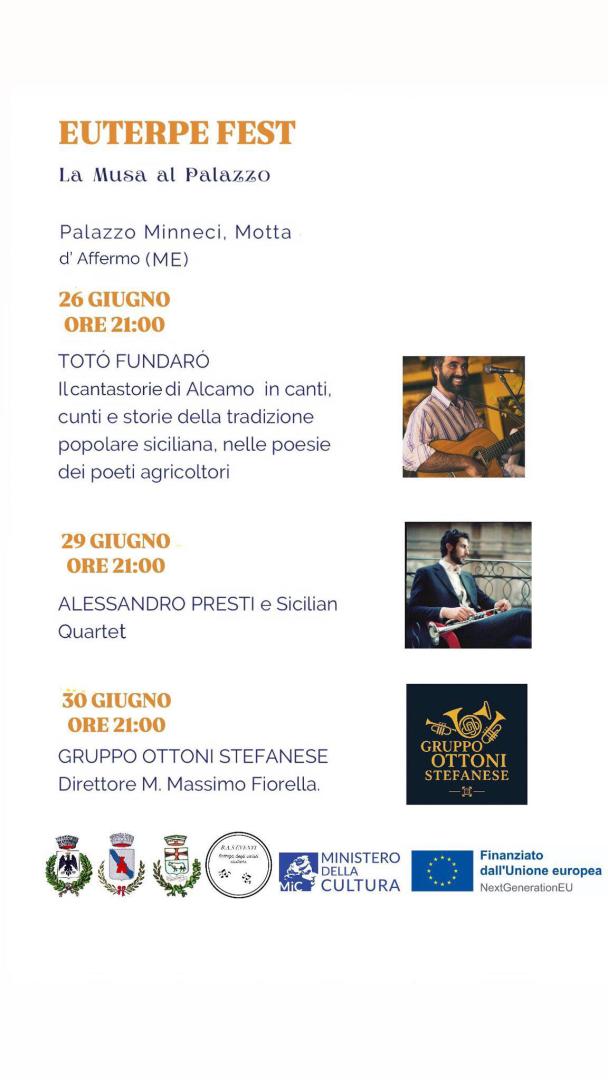
This is the Euterpe Fest, an interesting musical proposal that will take place on June 26th at Palazzo Minneci. The Muse of Music, Euterpe, will thus enter the restored halls of the historic residence to offer attendees some captivating musical moments, entrusted to distinguished artists who will propose a varied program ranging from folk traditions to jazz, concluding with a brass ensemble performance.
Here is the program with a brief description of the artists.
TOTÒ FUNDARÒ The storyteller from Alcamo in songs, tales, and stories of Sicilian popular tradition, in the poems of farmer poets. Totò Fundarò is an authentic heir to the tradition of Sicilian storytellers, a figure who combines peasant wisdom with narrative and musical mastery. He not only interprets and tells stories of Sicilian popular tradition but enriches them with his guitar, often with an expressiveness that recalls that of virtuous Spanish guitarists. His art is deeply rooted in rural life and the culture of the land, so much so that documentaries such as "I Villani" by Daniele De Michele and "Pi Amuri o pi Raggia" by Fabrizio Raggi have been dedicated to him. Fundarò is also a cultivator of ancient Sicilian grains and a member of Simenza, embodying an indissoluble link between art and his land.
ALESSANDRO PRESTI and Sicilian Quartet Alessandro Presti is a talented trumpeter, arranger, and composer of Motta d'Affermo origin, considered one of the most refined and sought-after of the new generation of Italian jazz. Trained between Italy (Messina, Siena Jazz) and the United States (New York), he has developed a style that combines the rigor of hard bop with an attention to the more contemporary idioms of jazz. He has collaborated with prominent figures such as Roberto Gatto and Francesco Cafiso, and boasts important recognitions such as the "Chicco Bettinardi" Award and the Top Jazz 2022 award in the Italian New Talent category. His music is deeply linked to Sicilian roots, with a strong attachment to the land and the local band tradition, which influenced his approach to the trumpet from childhood thanks to his father, a bandmaster.
GRUPPO OTTONI STEFANESE Director M. Massimo Fiorella. The Gruppo Ottoni Stefanese is an ensemble that promotes brass chamber music, offering a captivating repertoire that ranges from classical to lyrical, from jazz to pop, with original pieces, transcriptions, and arrangements. These brass groups, often composed of musicians with a solid classical and band background, are known for their ability to create unique and powerful atmospheres through the warm and resonant sound of brass wind instruments. The band tradition is very strong in Sicily, and the Gruppo Ottoni Stefanese carries on this heritage with professionalism and passion, under the direction of Maestro Massimo Fiorella.
You may also like...
Riccardo Zingone 18/08/2026
Sagra ru Cuddurune – Traditional Fried Dough Festival in Mistretta
Mistretta is ready to celebrate a traditional event organised by the Pro Loco Mistretta APS tourism association: the Sagra ru Cuddurune.
The festival promotes one of Sicily’s simplest and most authentic popular foods: pieces of bread dough fried and served either with salt or with sugar. This humble speciality has long enriched family tables across the island.
Bringing together flavour, tradition and conviviality, the event has received the support of Sicily’s Department of Productive Activities for the second consecutive year, confirming the cultural and community value of the festival.
The evening opens with the Amastra Folk Group, followed by Magic Salta, stilt walkers, soap-bubble performances and magic.
Tastings begin at 7:30 p.m. Live music is provided by Gli Assi, a popular band from Nicosia known for its energy and varied repertoire.
Riccardo Zingone 17/04/2025
Amastra per leggere in Mistretta from April 23rd to May 23rd Sicily
Mistretta is solidifying its position as a significant cultural hub in the Nebrodi region. Following its successful inaugural edition in 2024, the event titled "Amastra che legge in festa 2025, the Festival of Books and Reading" is making its return.
With the patronage of the Municipality of Mistretta and the collaboration of numerous local associations and educational institutions, the event promises to strengthen the deep cultural sensitivity already demonstrated by the Amastratina community towards books and culture. This characteristic allowed Mistretta to compete as a finalist for Italian Book Capital 2025 through a project of great cultural, social, and identifying value, stemming from its recognition as a "Reading City" in 2024 by Cepell.
The book, therefore, takes center stage for an entire month rich in exhibitions, presentations, readings, educational workshops, and debates. Thus, within the framework of "May of Books," it will be interpreted not only as a tool for cultural dissemination but also for social cohesion and growth.
The festivities kick off on April 23rd with the exhibition "M'illumino leggendo" (I Light Up Reading), part of World Book and Copyright Day, organized by the I.C. Tusa-Mistretta at the Municipal Library. This will be followed by an interesting dialogue, entirely in Mistrettese dialect, titled "Mistretta, Identity and Narrative," featuring Corriere della Sera journalist Alessio Ribaudo and Vito Ribaudo, Human Resources Director of RCS. In the following days, various authors will be met, including Margherita Neri, Sara Magnoli, Tea Ranno, Mariangela Biffarella, Francesca Maccani, Mattia Corrente, and Massimiliano Città.
The initiative benefits from the valuable collaboration of the Pro Loco Mistretta APS Association, the Tusa-Mistretta Comprehensive Institute, the IIS A. Manzoni Mistretta, the Libreria Capitolo 18, the Hakuna Matata Association, the La Valle delle cascate di Mistretta Association, and the FIDAPA section of Mistretta.
Riccardo Zingone 12/07/2025
Tourism in Inner Areas: A Value to Be Given Meaning
Inner Areas: Italy's True Beating Heart
For several decades, the so-called Inner Areas have been a priority on the political agenda and, by reflection, in the economic and social strategies of Italian regions. Long identified as the Achilles' heel of the national nervous system, Inner Areas, geographically distant from large urban agglomerations and peripheral in terms of access to essential services like healthcare, education, and mobility, nonetheless continue to host a significant portion of the Italian population. According to a recent 2024
We're talking about the Italy of villages rich in history, culture, and traditions, populated by people with ancient wisdom, heirs to an extraordinary tangible and intangible culture. These places boast countless beauties to discover among pristine mountains and seas, local stone constructions and red tiled roofs, interwoven with ancient alleys and small squares where time seems to stand still. These villages are special places, designed to live in symbiosis with their surrounding environment. They are extraordinary settings that offer a genuine identity, where every step forward seems to powerfully transport us back in time, in a virtuous loop that appears endless. At the same time, however, these places are symbols of fragility: often marginal and marginalized, far from essential services, and thus subjected to the relentless scythe of depopulation and economic and social impoverishment.
This phenomenon has not spared the western edge of the Nebrodi area, comprising the Municipalities of Mistretta, Santo Stefano di Camastra, Reitano, Castel di Lucio, Pettineo, Tusa, and Motta d’Affermo, as evidenced by data collected between 2002 and 2022 (ISTAT). The unforgiving numbers tell us that this area experienced an average population decrease of -17%, with peaks of -30%, in terms of resident population.
It's well-known that, precisely because of the characteristics described above, Inner Areas have, in recent years, attracted the interest of numerous tourists drawn to slow, immersive, and experiential tourism. This has created the conditions for a regenerative process within the villages themselves, but given the fragile context in which it could develop, it requires careful and targeted governance and organizational structuring.
The Culture of Hospitality: A Prerequisite for Tourism
"The culture of Hospitality does not coincide with tourism, but it is its prerequisite." (Andrea Succi)
In this direction, an innovative organizational model has developed over the years, already successfully applied in various regions of Italy, and which, in 2024, landed in Sicily. We are talking about the GMT™ (Territorial Marketing Group) format and the new figure of the CTT™ (Territorial Tourism Coordinator). The project stems from the decennial work of Dr. Andrea Succi, founder of the
The GMT™ Halaesa Nebrodi and Regional Applicability of the Model
Based on these premises, in January 2024, the GMT™ Halaesa Nebrodi was launched in Sicily, coordinated by me in my role as CTT™. It encompasses the Municipalities of Santo Stefano di Camastra, Reitano, Mistretta, Tusa, Pettineo, Castel di Lucio, and Motta d’Affermo.
Nestled between the western edge of the Nebrodi Park and the eastern edge of the Madonie, the Halaesa-Nebrodi area represents a unique blend of history, art, traditions, culture, geo- and biodiversity, in an exceptional symbiosis of sea, hills, and mountains. Undoubtedly, Halaesa Nebrodi has all the credentials to become an authentic Tourist Destination. With this objective, thanks to the synergy with over twenty economic operators, it is approaching a role and identity in professional tourism as a bearer and guardian of immense tangible and intangible knowledge, exemplified by the Ceramics of Santo Stefano di Camastra, the millennia-old history of Mistretta, the archaeological excavations of Halaesa Arconidea, the secular olive trees of Pettineo, the traditions linked to rural civilization, agri-food products, and the
Cultural Regeneration as a Starting Point
The seven Municipalities are thus represented in their singularities and specificities but integrated into a broader and shared context, in the conviction that cohesion and interaction between Municipalities can lay the foundations for the cultural, social, and economic regeneration of individual realities. Halaesa-Nebrodi, thanks to the pristine beauty of its characteristic villages and their inhabitants, has long been a tourist destination. However, in our project, we intend to propose this special place as an authentic Tourist Destination, coining and strengthening a brand that arises, almost naturally, from the synergy between different communities, and which, precisely in diversity, demonstrates its strength and conveys its great attractiveness. According to this model, local identities ("campanili") should not be demolished but reinforced and instead pooled into a broader and shared project. Communities and administrators are therefore called to dialogue, interaction, and sharing to chart a new regenerative path that can counteract the social and economic decline that we all have a duty to oppose, each with our own role and expertise.
The Role of Institutions
With a view to developing a shared project, the seven administrators were asked to approve an Action Plan that can lay solid foundations for territorial tourism planning through valuable and indispensable work in study, training, awareness-raising, consultancy, and support for operators and public administration. The GMT™ model, by its nature replicable and scalable, was presented in Nicosia during an interesting workshop, sparking the interest of administrators, economic operators, associations, and the