People of Halaesa Nebrodi: Chiara Dimaggio and her Domus Immobiliare Real estate Sicilia
Real estate agent and a dynamic, effective ambassador for the land: Chiara Dimaggio
Riccardo Zingone 16/01/2026 0
People of Halaesa Nebrodi: Chiara Dimaggio and her Domus Immobiliare
Face to face with Chiara Dimaggio, a young and brilliant real estate agent operating in the territory of Halaesa Nebrodi.
Through her agency, Domus Immobiliare, she is fulfilling her lifelong dream: making the people she meets happy by sharing her contagious smile with them. One of her slogans says: "Life takes you to unexpected places, Love brings you Home," and Chiara, interpreting this mission with exceptional enthusiasm, has found homes for many people — both Italian and foreign — to whom, above all else, she introduced the territory, its soul, and the people who live there, adding extraordinary value to her delicate and vital work.
Chiara, what is a real estate agent doing in a local tourism marketing group?
At first glance, the role of a real estate agent within a tourism-oriented territorial marketing group might seem distant. In reality, it is not at all. The presence of a real estate agent in a territorial marketing group is not a mere formality: it is an added value. I am firmly convinced that when a town grows, all the businesses connected to it grow as well.
The core objective of GMT™ Halaesa Nebrodi is the promotion of the Halaesa Valley territory, and on this front, the group is doing an excellent job. Such extensive promotion can only bring benefits to a business like mine, which for years has invested time, energy, and passion into enhancing the value of the territory.
__.jpeg)
Yours is a young journey, yet rich with experience in the real estate sector.
My business is young, just as I am. I opened my real estate agency at only 22 years old. I remember with pleasure what pushed me to embark on this adventure. I was preparing my last three subjects for my bachelor's degree when, in a moment of high stress, I decided to change direction. It was thanks to a reflection shared by my father that I chose to attend the real estate agent course.
From there, a world opened up: my world. I became licensed for the profession, earned a bachelor's degree in Political Science and International Relations, and subsequently a master's degree in Public Administration. Today, those degrees are hanging on the wall, because the passion for my work took over and grows day by day. If I am who I am today, I owe it to the professionalism and dedication with which I perform this job. For almost 11 years, I have been making people's dreams come true, and I hope to continue doing so for many years to come.
What role do you play in GMT Halaesa Nebrodi: can you give an assessment and what are the future prospects?
I immediately embraced the GMT™ Halaesa Nebrodi project and the ideas of its creator, Andrea Succi. From the very first meeting, I was struck by his spirit, his determination, and his desire to provide a concrete contribution.
The GMT™ operates in a territory that unfortunately has experienced significant depopulation and economic regression in recent years. However, the group is made up of young entrepreneurs and professionals who deeply believe in the potential of the place where they live. In these two years, through the launch of the website, participation in the recent BTE in Palermo, constant social media promotion, and the creation of travel packages, the GMT™ has helped to make the territory known and achieve its main goal: to grow and improve the entire Nebro-Alesino district.
Will we succeed? Yes, I am certain of it. Can we do more? Absolutely. We can and must always improve, but we have all the skills to do it.
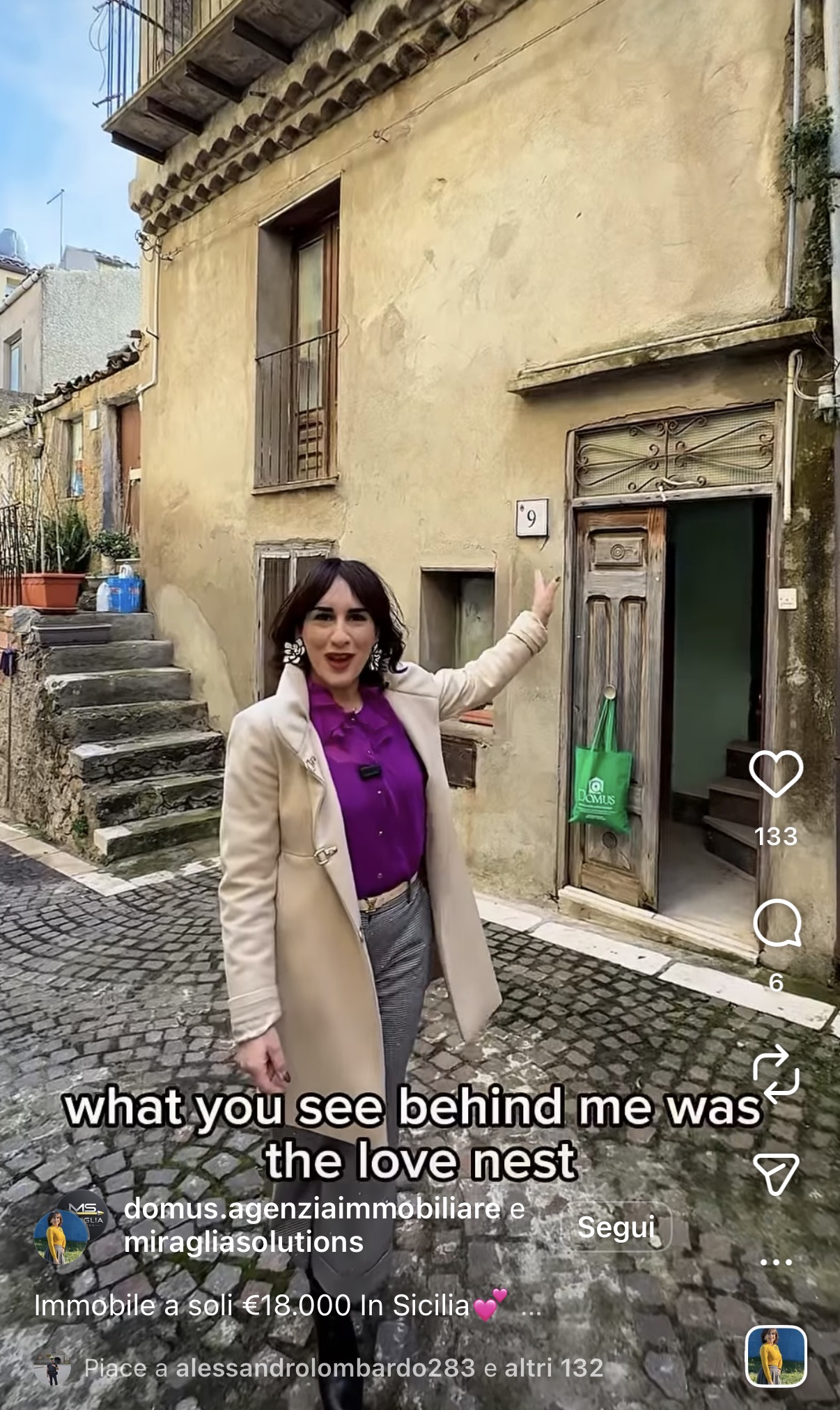
Social media and real estate: putting your face out there pays off.
The growth of my business has been strongly influenced by a constant and effective presence on social media. I say it and I will always repeat it: today, social media is decisive for the growth and image of a business. Once, newspapers were used; today everything passes through social networks, and I have fully embraced this change.
Through videos, I tell the story of the properties, but often also the stories of those who lived in them. I talk about the territory, with particular attention to Tusa, my grandparents' village, the place of my childhood and my heart. Thanks to this work — and I take credit for it — real estate transactions in the municipality of Tusa have increased exponentially, and today the village is known internationally. Putting your face out there is fundamental: people want to know who they are trusting. A logo creates distance; I, instead, build relationships based on trust, friendship, and respect.
What do you expect from the territory and what can be improved?
One of my greatest desires is to see the small villages flourish again. I imagine towns full of life, people, businesses, and lively venues. I wish that even those who live there daily would take an extra step to promote, beautify, and enhance them. I hope that local administrations can intervene with small improvements that, over time, could make a big difference.
I am very confident and, above all, proactive. Who knows, maybe our group, by joining forces, will manage to take giant leaps and surprise the territory around us. I invite anyone who wants to contribute to the growth of the territory to join the Territorial Marketing Group: together we can do great things.
You may also like...
Riccardo Zingone 18/08/2026
Open Honey Houses in Motta d’Affermo
On Sunday 17 November, “Mielerie Aperte – Open Honey Houses”, a nationwide project promoted by UNAAPI, returns to the Il Melograno agricultural and social farm in Motta d’Affermo, an active partner of GMT Halaesa-Nebrodi.
During the event, Elisa and Riccardo guide visitors through the fascinating world of bees and beekeeping, together with social organisations that work with the farm to provide inclusion services across the area.
Visitors can learn about bees and beekeeping, discover the treasures of the hive and taste a selection of Sicilian honeys.
Two visiting sessions are available, from 10:00 a.m. to noon and from 3:00 to 5:00 p.m., at the Open Honey House workshop, Via Belvedere 3, Motta d’Affermo.
For information and bookings, call +39 347 648 1284.
Halaesa Nebrodi 16/02/2026
Mistretta's Pasta Reale ignites an interesting comparison on social media
In Mistretta, attention has once again turned to one of the most identity-defining symbols of the local confectionery tradition: Pasta Reale. In recent days, Dr. Riccardo Zingone formally submitted to the Mayor of the Municipality of Mistretta, Dr. Sebastiano Sanzarello, a request to initiate the procedure for the inclusion of “Pasta Reale di Mistretta” in the regional list of Traditional Agri-Food Products (PAT), pursuant to the current regulations.
An identity heritage of the community
Pasta Reale represents one of the most authentic expressions of the gastronomic culture of Mistretta and the Nebrodi area. Prepared with finely ground almonds and handcrafted until a compact, oily dough is obtained, it forms the base of numerous specialties: from baked or raw pasta reale to the Easter lamb, up to the renowned marzipan fruit.
The production process, handed down from generation to generation, preserves knowledge and techniques that vary from producer to producer, making each interpretation unique while respecting a shared tradition. It is precisely this family-based and artisanal transmission—never fully revealing its “secrets”—that contributes to preserving its exclusivity and cultural value.
The request to initiate the procedure
In his official petition, Zingone emphasizes that Pasta Reale di Mistretta is not merely a confectionery product, but an identity element deeply rooted in the collective memory of the community. The request aims to safeguard its original characteristics in a context where, in recent years, the product has undergone reinterpretations and commercialization in other municipalities as well, with the risk of altering its distinctive features and recognizability.
Inclusion in the regional PAT list would represent an initial and significant institutional recognition, intended to formalize the historical and production characteristics of the dessert through a shared production specification and adequate technical-historical documentation.
Zingone has also declared his willingness to actively collaborate in preparing the necessary materials, involving scholars, artisans, and sector operators.
Support and the precedent of the De.Co. Regulation
The proposal immediately sparked discussion on social media (https://www.facebook.com/share/p/17zq3r5MFh/?mibextid=wwXIfr), gathering support from citizens and institutional representatives. Among the most significant contributions was that of Dr. Salvatore Antoci, who recalled that as early as 2012, in his role as City Councilor, he had proposed the adoption of the De.Co. Regulation (Municipal Designation of Origin) for typical products, with specific reference precisely to Pasta Reale.
The regulation, approved by the Municipal Executive in 2014 and again in 2015, and subsequently by the City Council, also provided for an identifying logo depicting Pasta Reale. However, although it was published on the official notice board, it was never concretely implemented and has effectively remained unenforced.
Antoci now proposes to resume from that very De.Co. Regulation, pending the procedure for recognition as a Traditional Agri-Food Product, thus equipping the Municipality with an immediate tool for protection and enhancement.
A shared path for the future
The perspective outlined by Zingone also looks beyond PAT recognition, envisioning in the future a path toward PGI status, which would require even more structured work in terms of production specifications, traceability, and promotion.
Beyond the technical aspects, the debate that has developed in the city highlights a significant fact: Pasta Reale is not merely a dessert, but a collective symbol around which an entire community identifies itself. The protection of traditional productions, in fact, concerns not only the economy or territorial marketing, but also the safeguarding of history, identity, and sense of belonging.
The matter now passes to the Municipal Administration, called upon to assess the initiation of the procedure and to coordinate work that will require historical research, dialogue with producers, and the drafting of production specifications capable of combining authenticity with openness to the future. The discussion is open, but one point appears shared: Pasta Reale di Mistretta deserves official recognition that affirms its value and preserves its most authentic soul.
(from Quadrochiaro.it, Anna Saitta, 14/02/2026)
Halaesa Nebrodi 08/08/2024
Saint Sebastian’s Feast in Mistretta – 18 August
Feast of Saint Sebastian in Mistretta: Religious Celebrations and Traditions
The city of Mistretta is preparing to honor Saint Sebastian the Martyr, Patron Saint of the Nebrodi community, with a rich program of events involving both faithful and visitors.
Start of Celebrations – August 11th
The festivities begin on August 11th with the solemn ringing of bells, marking the official opening of the celebrations in honor of Saint Sebastian. The evening will continue with a performance by the I.C. Tommaso Aversa Orchestra in "Note di Notte" (Night Notes), an unmissable musical event.
Triduum and Traditional Activities – August 15th-17th
From August 15th to 17th, the Triduum of Saint Sebastian will be characterized by numerous religious and cultural events. On August 16th, the XVIII edition of the Saint Sebastian Foot Race Trophy, a traditional sporting event, will take place. On August 17th, music and entertainment will enliven the city with the Euterpe Band, the Majorettes of Capizzi, the children of Hakuna Matata, and a performance by Alessandro Gandolfo.
Culminating Day – August 18th
August 18th is the most anticipated day: the Holy Mass will precede the Solemn Procession of the Simulacrum of Saint Sebastian and his relics, which will pass through the streets of Mistretta. To conclude, a fireworks display will illuminate the sky, followed by a show by Pippo Palmieri, directly from Radio 105's Zoo.
Concert by Danilo Sacco – August 19th
On August 19th, Danilo Sacco will hold a concert that promises to engage and captivate the audience. The evening will conclude with the drawing of raffle prizes, adding a further touch of excitement to the festivities.
Closing of Celebrations – August 25th
The festivities in honor of Saint Sebastian will officially conclude on the following Sunday, August 25th, with the traditional solemn ringing of bells that will bid farewell to participants and close this week of celebrations.