Blog
Halaesa Nebrodi 05/10/2025 0
"Giuseppina Azzolina wins the 'Entrepreneurship and Management' Award 2025" 🏆
Recognition for Youth Entrepreneurship to an Operator of Halaesa Nebrodi
The current year continues to hold pleasant surprises for the Territory, for GMT™ Halaesa Nebrodi, and for the Operators who are part of it.
After recently telling the story of Elisa Cerrito and the Il Melograno Farm in Motta d'Affermo, which won a prestigious award in the field of beekeeping ([link to the article]), on October 4th, another young entrepreneur from Halaesa Nebrodi received an important recognition. She is Giuseppina Azzolina from Castel di Lucio, who was awarded in the context of the fourth edition of the "Una di tante" (One of Many) competition, organized by the Pro Loco of Nicosia.
Giuseppina Azzolina and her kiosk, "Al passo di Eolo" (At the pace of Aeolus), won the award in the Entrepreneurship and Management section. This important recognition was assigned following the suggestion of the Mayor of Castel di Lucio, Giuseppe Giordano, who in this way wanted to give due and deserved credit to the very young 25-year-old entrepreneur from Castel di Lucio. We recall that in the previous edition, another entrepreneur from Castel di Lucio, Franca Sacco, was awarded for her activity in the dairy sector, and in the same year, the Entrepreneurship and Management award was assigned to the entrepreneur from Mistretta, Maria Grazia Insana.
A Choice of Heart and Courage
Like many young people her age, at a certain point in her life, Giuseppina found herself at a crossroads: leave or stay? The love for her land, for her family, and for her town became determining factors in her difficult choice. Her decision was firm: Castel di Lucio, a mountain town of just over 1200 inhabitants perched on the Nebrodi Mountains, has been and will continue to be her home.
"A courageous choice, far from obvious, that has had an important impact on the entire community," underlined the Mayor during the award ceremony, "because with her gesture, she has restored dignity to the town."
The Birth of "Al passo di Eolo"
Giuseppina's family owns land a few minutes from the famous land art installation, The Labyrinth of Ariadne (Il Labirinto di Arianna), a highly frequented destination that is part of Fiumara d'Arte, Europe's most extensive open-air contemporary art park. On this land, located on a knoll exposed to the four winds with a breathtaking view, Al passo di Eolo was born in 2021, a small family-run kiosk where Giuseppina and Mimma, her dynamic mother, manage the kitchen and welcome guests.
From its beginning, Al passo di Eolo has stood out for its menus, a triumph of Sicilian cuisine: from cutting boards of fresh cured meats and cheeses to more substantial dishes like sandwiches with sausage and ricotta. There is no shortage of sweet delicacies, such as fresh cannoli, all served with refreshing drinks or a good coffee. The dishes are often presented on unique wooden cutting boards, hand-carved in the shape of a labyrinth, adding a special touch to the experience. Even on the cutting boards, there is, in a way, the family's mark, as they are handcrafted by her carpenter father who, obviously, also created all the wooden structures.
From that moment on, Al passo di Eolo became a genuine reference point for the territory and for the town of Castel di Lucio because, as the Mayor recalls, "it creates Value by uniting Art, Territory, and high-quality gastronomic Products, but it is also an important information point serving travelers."
"My award comes from a long way, the result of great sacrifices and supported by the closeness of my whole family," an emotional Giuseppina recounts. "I decided to stay and invest in the Territory, and it is to the Territory that I dedicate this award."
Beautiful words full of meaning, which aim to be an example for those who want to make their Territory their Home.
Riccardo Zingone 04/10/2025 0
The Hyblaean Mountains meet the Nebrodi Mountains in an interesting gastronomic journey
Halaesa Nebrodi: A Journey of Flavors Between the Hyblaean and Nebrodi Mountains
The main objective of the CTT™ Territorial Tourism Coordinator of Halaesa Nebrodi is the promotion of the territory as an expression of a specific identity. Its "genius loci" is characterized by the diversity offered by the individual municipalities, which benefit from a catalytic and multiplying effect when put in synergy. Along the path started a few years ago, I've met and crossed paths with countless people: operators, administrators, travelers. But the story I want to tell you today has some very interesting nuances that, in my opinion, deserve a closer look, directly involving three of our Operators.
The Taste of Excellence: The Meeting with Èstro Restaurant
Giuseppe Luparelli (chef) and Lorenzo Sorrentino (pastry chef) are the owners of Èstro Restaurant (link: [Èstro Restaurant] ) in Palazzolo Acreide (SR). Their cuisine, while firmly rooted in the valuable gastronomy of the Hyblaean Mountains, is pleasantly open to regional, national, and international influences. Seasonality is a fundamental element of their philosophy, while innovation and the reinterpretation of dishes in a contemporary key represent the added value the team offers its customers.
In this continuous journey of enrichment and constant improvement, Giuseppe and Lorenzo are looking for new ideas to embellish their dishes and, why not, invent new ones. Driven by this passion, they decided to contact Halaesa Nebrodi in search of flavors and gastronomic traditions from our territory.
The request was simple: to visit some local businesses within a few days in search of local products of excellence and, if possible, unique ones.
Organizing the Mini-Tour
We collaborated on how to organize and optimize the mini-tour, given the long distance between Halaesa Nebrodi and the Hyblaean region and the relatively little time available. We drew up a three-stage program: visits to two farms and lunch in Mistretta.
Stop 1: The Provola D.O.P. from Azienda Antonio Fioriglio
The first farm visited by Giuseppe and Lorenzo is located in the territory of Mistretta, leaving the SS 117 a few kilometers after cresting Serra Merio (1093 mt). This is the Azienda agricola zootecnica Antonio Fioriglio (link: [Azienda agricola zootecnica Antonio Fioriglio]), known everywhere for the famous Provola dei Nebrodi D.O.P. Here, immersed in 100 hectares of green and uncontaminated pastures of the Nebrodi Park (Zone B), the company stands strong with a long family history dating back to 1890, now in its fifth generation.
Welcoming Giuseppe and Lorenzo was Biagio, Antonio's son, who, along with his brother Paolo, dedicates himself with love and dedication to the family business. The tasting was "challenging": in addition to the inevitable Provola dei Nebrodi D.O.P., Biagio offered a rich platter consisting of other seasoned and unseasoned cow's milk cheeses, warm fresh ricotta that had just been produced, and, the icing on the cake, the prized baked ricotta (ricotta infornata), queen of several island dishes, including the famous Pasta alla Norma.
Stop 2: Authentic Flavors at Turismo Rurale SESIMA
As it was nearly lunchtime, our Giuseppe and Lorenzo left the Fioriglio farm amid the ringing bells of the cows and headed towards Turismo rurale SESIMA (link: [Turismo rurale SESIMA]).
The ancient farmhouse is located along the SS 117, right at the entrance to Mistretta when arriving from the hinterland. The view you can enjoy once you arrive is truly breathtaking: the gaze wanders across the pastures of the great valley up to the peaks of the Nebrodi Mountains, made green by ancient and lush forests.
Here, the two chefs met Simona Di Gregorio, the hostess and kitchen manager. Despite the generous earlier snack, there was still room for fresh bucatini with Nebrodi Black Pig and a sumptuous Nebrodi Florentine Steak (Fiorentina) to share. An excellent way to come into contact with the superb local meats.
Stop 3: Innovation and Tradition with Messinese Goat Salami
The journey of our chef friends continued towards Santo Stefano di Camastra (link: [Santo Stefano di Camastra]) intrigued by the news regarding the recent launch of a new product: the Messinese Goat Salami (Salame di Capra messinese), which we recently covered in this article.
The Azienda di Antonino Mallaci Bocchio (link: [Azienda di Antonino Mallaci Bocchio]) , located in the territory of Cerami, close to that of Mistretta, officially introduced an innovative product to the market that, in reality, has solid roots in the past and tradition of the Nebrodi. The sales point, La dispensa del Massaro (link: [La dispensa del Massaro]) , is located right in the City of Ceramics, and here Giuseppe and Lorenzo were welcomed by Antonino, who presented them, in addition to the Goat Salami and the Nebrodi Black Pig Salami, a series of dairy products derived from goat's milk.
Mission Accomplished
This is the story of an exceptional day dedicated to promoting the territory, but what matters most are the impressions collected by Giuseppe and Lorenzo:
"Today we took a journey to discover the authentic Sicily, one made of ancient flavors and traditions. The first farm, that of Antonio, Biagio, and Paolo, showed us products of great value but also people with big hearts. Leaving the SS 117 and following the navigator, we got lost, but thanks to Antonio's helpfulness, we managed to reach the farm (Editor's Note: unless you have a 4x4, it's advisable to arrive at the gates of Mistretta and head towards Contrada Fontana Murata). The welcome was excellent, as were all the products we tasted, especially the baked ricotta which we found special and different from what we use in our area. Its delicate taste pleasantly struck us.
Likewise, lunch at SESIMA met our expectations and stimulated new gastronomic ideas, just as learning about the goat products from Antonino's farm in Santo Stefano di Camastra convinced us to experiment and propose something new to our guests.
Our menu, already rich in excellent products, will be enhanced by a fresh pasta dish with goat ragù, dusted with baked ricotta."
So, mission accomplished! The Hyblaean Mountains marry the Nebrodi Mountains through a unique dish that unites two fascinating worlds of our splendid Island.
Halaesa Nebrodi 29/09/2025 0
Il Melograno Farm: Excellence Among Sicily’s Wildflower Honeys
The prestigious recognition was awarded during the "Millefiori Siciliani" Competition, held in Sortino (SR) on September 26, 2025, and organized by A.R.A.S. – the Regional Association of Sicilian Beekeepers.
The judging panel evaluated 86 honey samples from across Sicily, the result of the passionate work of numerous beekeepers who submitted the finest products of their production to a rigorous selection process.
At the end of the tasting sessions, 35 honeys were selected, of which 14 received the distinction of “excellent” and 21 were awarded “very good.”
The results concerning our territory, represented by Il Melograno Farm of Elisa Cerrito, were particularly gratifying: the farm was awarded first and fourth place in the Sicilian Spring Wildflower Honey category.
This is a great source of pride—not only a personal one for Elisa Cerrito and Riccardo Presti, who for years have pursued a virtuous path rooted in respect for local traditions and the production of high-quality honey made possible by the great variety of plants they cultivate—but also because of the strong social value of the project they have long been committed to, through their collaboration with Don Mazzi’s Exodus Foundation and the many educational sessions dedicated to students, where they passionately share the "wonderful world of bees."
“Such a prestigious evaluation not only highlights our dedication as beekeepers, but once again confirms the richness and value of the land where our precious bee friends grow and feed: the territory of Motta d’Affermo and its surroundings,” says Elisa, dynamic Operator of GMT™ Halaesa Nebrodi, further emphasizing how biodiversity, respect for nature, and the authenticity of our land naturally manifest themselves in the production of honey and its derivatives.
Riccardo Zingone 20/09/2025 0
Nino Mallaci, the Capramal Project, and his Messina goat salami
The Story of Nino's Goat Salami
To tell the story of the goat salami produced by Antonino Mallaci Bocchio—or Nino, as he's known to everyone—we need to take a big step back and listen to his history, which is rooted in an old family business dedicated to agriculture and animal husbandry.
"I come from a family of farmers and ranchers," Nino says. "I've always been fascinated by this world, which is rich in values and feelings, but also requires huge sacrifices."
As a boy, Nino split his time between school and the family business. After earning his surveyor's diploma, he decided to leave his studies to dedicate himself fully to the work, which at the time was primarily raising cows. "Our grazing lands were located between Mistretta, Cerami, and Agira, which required a lot of organizational and financial energy," he explains. In the late nineties, in his twenties, he and his father decided to build a barn on their land in the Calogno district, in Cerami but adjacent to Mistretta. Since then, all of his work has been focused there.
Like many livestock farms, Nino's also had goats and pigs. "I remember as a child," Nino continues emotionally, "I would often watch the preparation of various cured meats, including goat salami, which was made by mixing goat meat, naturally lean, with the leftover scraps from processing pork. I never forgot those flavors, those smells, and those healthy traditions. For a long time, I set a goal for myself to keep them alive through my business and my retail shop."
La Dispensa del Massaro and a Found Dream
Fast forward to today, Nino opened a store in Santo Stefano di Camastra, where he started La Dispensa del Massaro. The goal was to promote and sell cured meats from the Nebrodi Black Pig, a product of local excellence, along with select beef. However, the thought of the goats continued to "graze" in his mind, along with the project of bringing their related culinary traditions to everyone's tables.
At one point, Nino had the opportunity to buy a number of certified Messina goats, an indigenous breed with roots between the Nebrodi and Peloritani mountains, prized for the quality of its milk and the goodness of its meat.
"With the purchase of this flock," Nino says, "I felt I was close to realizing my dream, but I was also aware that I had to acquire more knowledge to be able to produce a quality cured meat that honored both tradition and modern standards."
He decided to attend a specific course in Alba, Piedmont, an area with a long and established tradition in raising goats and producing cured meats. After various experiments, he succeeded in producing his own goat salami, finding the right balance of compactness, resistance to slicing, preservation, flavor, and aroma.
A Product that is a Synthesis of Tradition and Innovation
Nino's long and complex journey, supported by his family, culminated on September 18th with the official presentation of the Capramal project in Santo Stefano di Camastra. The event was attended by administrators, technicians, friends, and curious onlookers, all drawn by this tasty new product.
The gastronomic experience of tasting the goat salami was enriched by specialties produced by other local businesses: the Spina Santa company from Nicosia, which specializes in producing goat cheese, and the Casaleni company, which has long offered excellent gastronomic products. Thanks to these synergies, it was discovered how the Messina goat salami is particularly enhanced when paired, for example, with sweet provola cheese and fig jam.
A perfect synthesis of the values expressed by the Messina goat salami is captured in the words of Dr. Serena Nigrelli, the agronomist who followed Nino during the bureaucratic process: "Nino's salami is one that should be savored with your eyes closed, because that's how we can grasp unique sensations that take us back in time."
All that's left is to wish Nino and his dream-come-true sincere good luck. The territory needs this energy, vision, and enthusiasm so that our beautiful traditions can transform from memories into concrete realities.
Contact info@halaesanebrodi fro more information.
Riccardo Zingone 16/08/2025 0
Mario Biffarella and Remembrances five years after his passing
I believe Mario had an absolute blast last night. He, who always maintained that the dead never truly die but observe us from the afterlife, from another dimension, I saw him sitting on the steps of his house, on a small street near the Church of Santa Caterina in Mistretta. He was watching, watching us, and watching himself.
His clever, deep, and gentle gaze, curious like the goblins he loved to paint, rested on the faces of those who, five years after his passing, had decided to accept the invitation from family and friends to attend a cool August evening dedicated not to his commemoration, but to his memory.
He had a blast, as I said. I noticed it when he was in stitches, listening to the words of his close friend, Tatà. Growing up with a person, sharing their battles, passions, bold and unconventional choices, their successes and failures, is the fertile ground where a sincere, deep, and timeless friendship germinates, grows, and matures. This is why Tatà, in talking about Mario, couldn't help but talk about himself. And vice versa. Mario, sitting on those steps, laughed and Tatà smiled, between one anecdote and another, as he spoke to us about Mario the boy, Mario the artist, Mario the philosopher, Mario the politician, Mario the "communist," Mario the writer, Mario the man.
At a certain point, however, Mario's amused expression changed, becoming more introspective. The scene was changing, and Mario was changing too. His son Alvaro took up his guitar, adjusted the microphone, and, along with Valentina, began to sing the first notes of "La canzone di Marinella," by that De André whom Mario, so long ago, had introduced to his own son.
Mario had sung De André over and over at home, during get-togethers, maybe even with his group, Gli Elfi, but now, hearing it sung by Alvaro, it moved him and, at the same time, pleased him. "Alvaro is really good," he thought to himself, as the magic of the music spread along the narrow street crowded with people. Then I saw him go down the stairs and play the last verse along with them:
"This is your song, Marinella Who flew to the sky on a star And like all the most beautiful things You lived only for a day, like the roses And like all the most beautiful things You lived only for a day, like the roses."
While Alvaro and Valentina continued their musical performance, Mario, Liria, and Ferruccio led us up the stairs into what is now a small museum. It holds paintings, sketches, writings, and various documents produced by Mario during his long artistic life, carefully preserved by his family in that treasure trove of material and immaterial culture that Tatà would like to turn into a Foundation. It is the studio-workshop where Mario unleashed his exceptional artistic sensibility, his ironic, sarcastic, irreverent, bold, and fascinating, yet also gentle, brush. The colors, the painted figures with their almost photographic appearance, the symbols and symbolisms, the gnomes, toads, open books, and faces have always struck me.
The Rimembranze exhibition will also be open today, August 16th, from 7:00 PM onwards. If you look closely, Mario will still be there watching, watching us, watching himself.
For more information:
Riccardo Zingone 20/07/2025 0
People of Halaesa Nebrodi: Martin Declève and his Royal Residence
The Story of Romei
The Contrada Romei, located in the territory of Mistretta, is one of the most iconic rural areas in the heart of the Nebrodi region. It's believed that, according to the descriptions by Silius Italicus and Polybius, the ancient city of Noma once stood here, and that the name "Romei" derives directly from the ancient inhabitants of this Greco-Roman city, the Nomei.
Nestled along the eastern slope that winds up towards Contrada Zupardo, near the Serravalle torrent, the former Romei feudal estate was renowned for its abundant production of grapes, citrus fruits, olive oil, and various other fruits. At one time, mulberries were also extensively cultivated here, their leaves serving as food for silkworms. The fertility of the land, combined with the mild climate, encouraged the inhabitants of Mistretta to settle here, as evidenced by the numerous ancient farmhouses still present.
After 1684, the Fief was assigned to Santo Stefano di Camastra but, following various legal disputes, a portion of it returned to the ownership of the Municipality of Mistretta. This led to a sell-off, and many lands were ceded to powerful families such as the Allegra, Natoli, Salamone, Armao, and Aversa, who built prestigious villas. Over time, this district became so populous that it warranted the presence of a detachment of Mistretta's elementary school, housed in a dedicated building where dozens of children were educated. This continued until the 1960s, as recounted and documented by Nella Faillaci, a passionate local history researcher and former head of the Municipal Historical Archive of Mistretta.
Today, the former Romei Fief is experiencing a new season: many of the old families no longer exist, but several estates have gained new life thanks to the interest of numerous new owners who have decided to make these places their home. It's from this interesting regenerative impulse that our story begins.
Palazzo Natoli-Giaconia: A Pearl Set Among Ancient Oaks and Olive Trees
I arrive for my appointment with Martin a few minutes before the scheduled time. He had informed me of a delay shortly before but had given me permission to enter the property. As soon as I step out of the car, which had until then protected me from the summer heat and isolated me from sounds and smells, I'm literally enveloped by the beauty of the place and the incessant chirping of cicadas. There are experiences that transport us back in time, and immediately I feel immersed in an unexpected situation that deserves respect: the ancient farmhouse hosting me, the "Regale dimora" (Royal Residence, as described in pencil on a wall by a guest), radiates extraordinary energy.
I feel like a guest in a place of great sanctity and, for this reason, I move on tiptoe. Even the ancient stone pavement deserves respect, and I tread upon it with circumspection.
While waiting for Martin's arrival, I wander around the courtyard of the imposing, yet well-integrated, historic residence, surrounded by ancient olive trees and dense woodland. Peering here and there, my attention is immediately captured by a spectacular fountain with the date 1761 carved into it. Water flows, and there is life. The central sculpted figure is nestled in a stone niche that still retains red decorations, a characteristic also visible along the main two-story facade, which features a spectacular double-ramp staircase leading to the upper floor. Indeed, I notice how the red with which the ground floor walls were painted is still visible on the facade, which, together with yellow and green, must have given the building a particularly elegant and classical appearance. After all, we are in the midst of Neoclassicism, and the echo of the archaeological excavations of Pompeii and Herculaneum evidently reached here too, leaving its mark on this building. 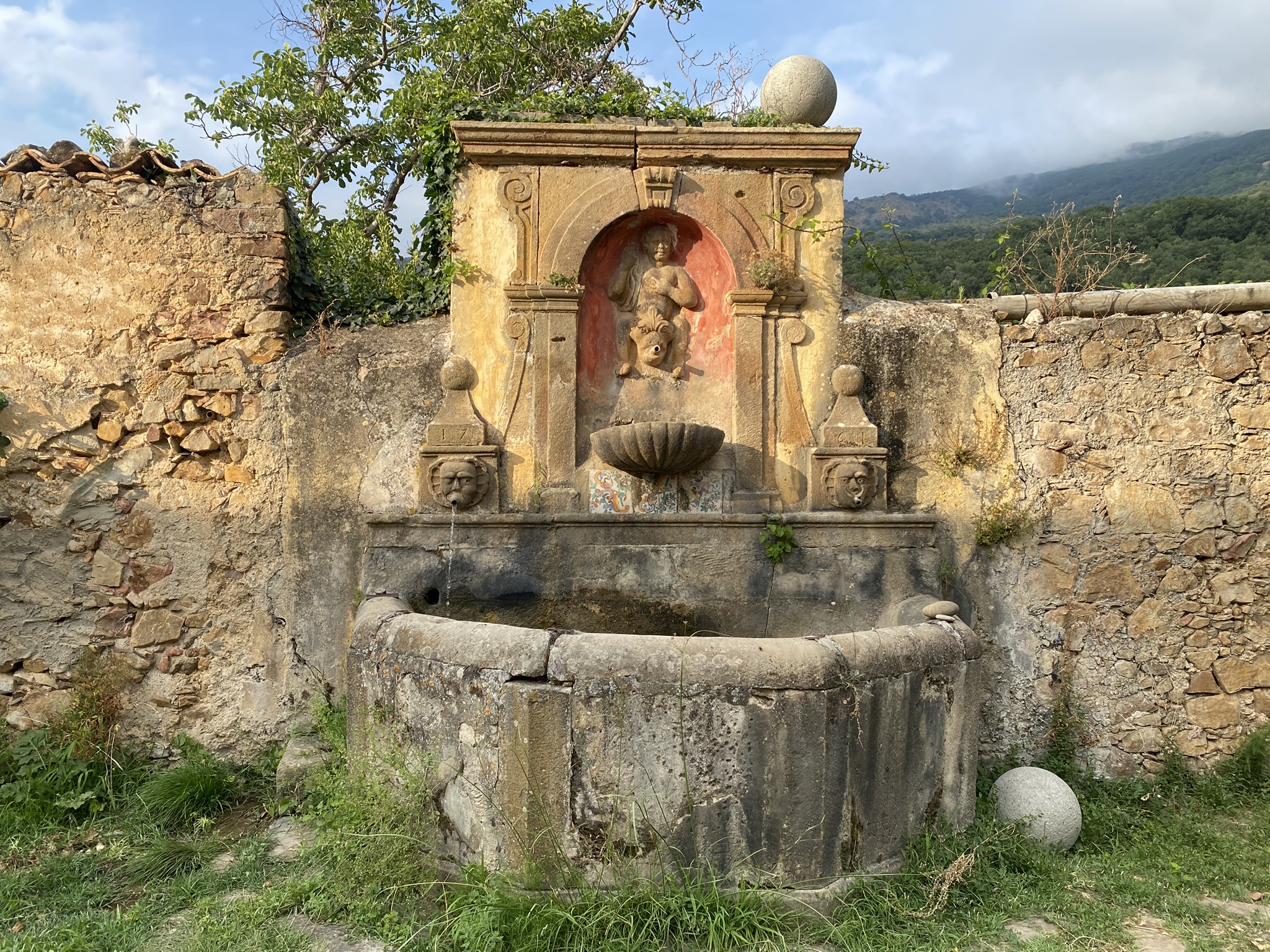
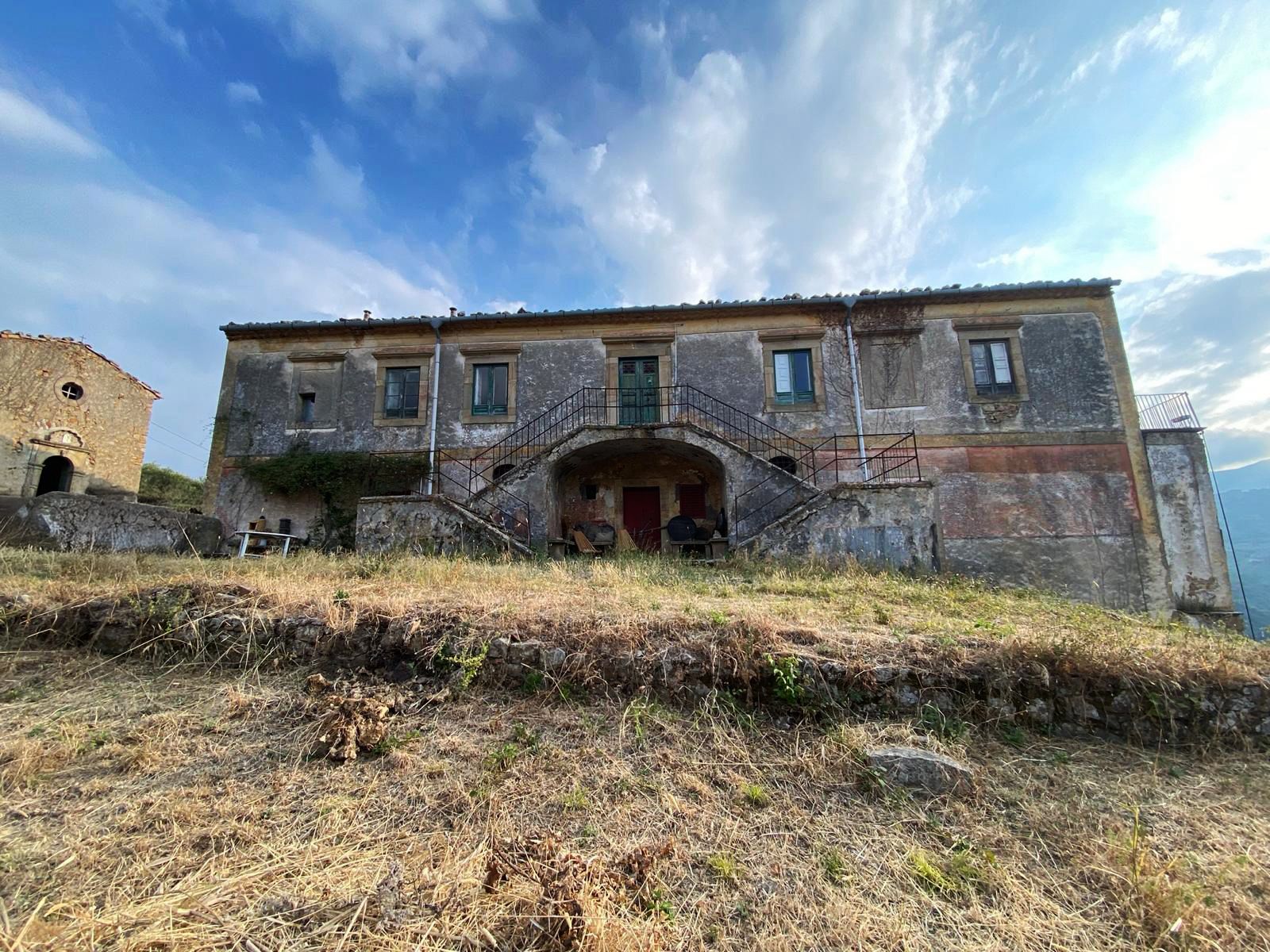
I find some doors open that lead to the warehouses where an ancient olive mill is still visible, with its enormous stone millstone and press operated by pack animals. Electricity would arrive very late in these parts, but the old owners, heirs of the Natoli-Giaconia family, had in the meantime circumvented the problem by purchasing a modern system located in another building and powered by a generator. The mill remained in operation until the 1960s, becoming the reference point for the surrounding area for olive milling.
Next to the building is the completely unadorned rural church, dated 1783, with a small altar and majolica floor at the back.
Martin Décleve and Valérie Verdinne: From the Pandemic to Their Dream
The chirping of the cicadas is momentarily interrupted by the arrival of a car: it's Martin, who greets me with a warm smile, which I promptly return.
We begin sipping a cool aperitif on the terrace, which accompanies our pleasant chat, during which Martin tells me about himself and what brought him here from Belgium.
"It's a project that started a long time ago: I taught Latin and Greek for twenty-two years, and my wife Valérie inherited a family pharmacy, but we both had a desire to dedicate ourselves to art. So, at a certain point, I left teaching to pursue photography and cinematography professionally, and, with Valérie, we restored a house in Brussels together. During the pandemic, despite the restrictions, we started traveling in Italy until we arrived in Sicily, where we encountered this territory that immediately fascinated us."
"Valérie and I," Martin continues, "always thought about buying a property with special characteristics, one that would tell a story by itself, and we thought that in this area, sooner or later, we would find it. We didn't entrust our search to real estate agencies, but rather to word-of-mouth. So, thanks to common acquaintances, we were put in touch with the old owners, and after a while, our search concluded."
After the pandemic, Martin and Valérie bought the property from the Parlato-Martorana family and immediately began cleaning and recovering the grounds, but not the building itself. This was a deliberate choice. "For now, we are focusing on cleaning the eighteen-hectare land," Martin continues, "but for me, it's a real spectacle to recover it little by little. Every day is a new discovery, and that's beautiful! The goal is to clean about four hectares and leave the rest as woodland. The house will only be renovated when we fully understand which direction to take. We are looking for a model to apply, but the common ones don't satisfy us, so we will wait as long as necessary. We plan, however, to create a model that combines culture with agriculture."
The DDT Project is Born: Contemporary Art Marries History
"Two years ago, Valérie, some friends, and I spent our first summer in this place. Outside, it was still a jungle, but we all perceived the charm that emanated from the whole: peace, beauty, the land, history. In the meantime, we abandoned the idea of creating a farm holiday resort and simply dedicating ourselves to hospitality and catering. So we took a break, and now we are looking for a deeper, more spiritual purpose, creating a reality where our desire for creation can be shared. I can't imagine a day without creativity, without the desire to create, and with Valérie, we believe we can develop a life model that transmits happiness."
"We then shared the idea of setting up an exhibition now, leaving and presenting the building as we found it, using the many rooms to host the creations."
As stated in the press release, the DDT project uses the message found on the wall as the title of this initiative, but above all, it elevates it to a keyword full of expectations, in a residence that, in fact, at the moment, offers nothing regal but a rare, expansive sense of cathartic peace. Unlike A and G, the two unknown individuals who signed the graffiti with only their initials after a short stay more than one hundred and twenty years ago, Declève and Verdinne are well aware that in the long term of their stay, the undertaking will consist of "giving time back to the temporary."
Next to the entrance door, on the wall, some dates traced in red paint can be read: above, 1761, that of the foundation of the structure; on both sides of the door, dates ranging from 1948 to 1967 refer to the period of DDT spraying against malaria. Over the centuries mentioned, the place has undergone numerous transformations. But it is undoubtedly during the mid-century following the ban on the insecticide, at the end of the 1970s, that the most radical metamorphosis occurred: the conclusion of agricultural activity, the abandonment of the land, and the use of the main building, left for more than thirty years, as an occasional holiday home. The DDT years were those of the "great acceleration." Beyond the illusory desire to distance this recent past, the misappropriation of the acronym expresses the new owners' desire to make this place a place of agriculture and culture, a space where time can be given back to the provisional.
DDT project – Before leaving this royal residence
Artists: Régis Baudy, Sébastien Bonin, Alessandro Costanzo, Étienne Courtois, Martin Declève, Myriam El Haïk, Laurent Friob, Anna Guillot, Sebastiano Leta, Renee Marcus Janssen, Emmanuel Piron, Rawakari, Agostino Rocco, Alfredo Sciuto.
DDT project: Martin Declève & Valérie Verdinne Dimora del temporaneo, Mistretta, Contrada Romei, Sicily, Italy 16.08—14.09.2025 Opening: Saturday 16—Sunday 17 August
(1) Romei, crocevia dei pellegrini. Nella Faillaci, Il Centro storico-giugno 2003
Riccardo Zingone 12/07/2025 0
Tourism in Inner Areas: A Value to Be Given Meaning
Inner Areas: Italy's True Beating Heart
For several decades, the so-called Inner Areas have been a priority on the political agenda and, by reflection, in the economic and social strategies of Italian regions. Long identified as the Achilles' heel of the national nervous system, Inner Areas, geographically distant from large urban agglomerations and peripheral in terms of access to essential services like healthcare, education, and mobility, nonetheless continue to host a significant portion of the Italian population. According to a recent 2024
We're talking about the Italy of villages rich in history, culture, and traditions, populated by people with ancient wisdom, heirs to an extraordinary tangible and intangible culture. These places boast countless beauties to discover among pristine mountains and seas, local stone constructions and red tiled roofs, interwoven with ancient alleys and small squares where time seems to stand still. These villages are special places, designed to live in symbiosis with their surrounding environment. They are extraordinary settings that offer a genuine identity, where every step forward seems to powerfully transport us back in time, in a virtuous loop that appears endless. At the same time, however, these places are symbols of fragility: often marginal and marginalized, far from essential services, and thus subjected to the relentless scythe of depopulation and economic and social impoverishment.
This phenomenon has not spared the western edge of the Nebrodi area, comprising the Municipalities of Mistretta, Santo Stefano di Camastra, Reitano, Castel di Lucio, Pettineo, Tusa, and Motta d’Affermo, as evidenced by data collected between 2002 and 2022 (ISTAT). The unforgiving numbers tell us that this area experienced an average population decrease of -17%, with peaks of -30%, in terms of resident population.
It's well-known that, precisely because of the characteristics described above, Inner Areas have, in recent years, attracted the interest of numerous tourists drawn to slow, immersive, and experiential tourism. This has created the conditions for a regenerative process within the villages themselves, but given the fragile context in which it could develop, it requires careful and targeted governance and organizational structuring.
The Culture of Hospitality: A Prerequisite for Tourism
"The culture of Hospitality does not coincide with tourism, but it is its prerequisite." (Andrea Succi)
In this direction, an innovative organizational model has developed over the years, already successfully applied in various regions of Italy, and which, in 2024, landed in Sicily. We are talking about the GMT™ (Territorial Marketing Group) format and the new figure of the CTT™ (Territorial Tourism Coordinator). The project stems from the decennial work of Dr. Andrea Succi, founder of the
The GMT™ Halaesa Nebrodi and Regional Applicability of the Model
Based on these premises, in January 2024, the GMT™ Halaesa Nebrodi was launched in Sicily, coordinated by me in my role as CTT™. It encompasses the Municipalities of Santo Stefano di Camastra, Reitano, Mistretta, Tusa, Pettineo, Castel di Lucio, and Motta d’Affermo.
Nestled between the western edge of the Nebrodi Park and the eastern edge of the Madonie, the Halaesa-Nebrodi area represents a unique blend of history, art, traditions, culture, geo- and biodiversity, in an exceptional symbiosis of sea, hills, and mountains. Undoubtedly, Halaesa Nebrodi has all the credentials to become an authentic Tourist Destination. With this objective, thanks to the synergy with over twenty economic operators, it is approaching a role and identity in professional tourism as a bearer and guardian of immense tangible and intangible knowledge, exemplified by the Ceramics of Santo Stefano di Camastra, the millennia-old history of Mistretta, the archaeological excavations of Halaesa Arconidea, the secular olive trees of Pettineo, the traditions linked to rural civilization, agri-food products, and the
Cultural Regeneration as a Starting Point
The seven Municipalities are thus represented in their singularities and specificities but integrated into a broader and shared context, in the conviction that cohesion and interaction between Municipalities can lay the foundations for the cultural, social, and economic regeneration of individual realities. Halaesa-Nebrodi, thanks to the pristine beauty of its characteristic villages and their inhabitants, has long been a tourist destination. However, in our project, we intend to propose this special place as an authentic Tourist Destination, coining and strengthening a brand that arises, almost naturally, from the synergy between different communities, and which, precisely in diversity, demonstrates its strength and conveys its great attractiveness. According to this model, local identities ("campanili") should not be demolished but reinforced and instead pooled into a broader and shared project. Communities and administrators are therefore called to dialogue, interaction, and sharing to chart a new regenerative path that can counteract the social and economic decline that we all have a duty to oppose, each with our own role and expertise.
The Role of Institutions
With a view to developing a shared project, the seven administrators were asked to approve an Action Plan that can lay solid foundations for territorial tourism planning through valuable and indispensable work in study, training, awareness-raising, consultancy, and support for operators and public administration. The GMT™ model, by its nature replicable and scalable, was presented in Nicosia during an interesting workshop, sparking the interest of administrators, economic operators, associations, and the
Halaesa Nebrodi 09/07/2025 0
Summer events calendar in the municipalities of Halaesa Nebrodi
If you're looking for a place where history, culture, and entertainment blend harmoniously, Halaesa Nebrodi is your next ideal destination. We're thrilled to invite you to immerse yourself in a unique experience, rich in events that will capture your every interest.
A Calendar Full of Emotions
Get ready to live unforgettable moments with a packed calendar of events designed for every taste:
-
Music: Let yourself be carried away by the melodies that will resonate through our streets, with concerts ranging from the most traditional genres to more contemporary notes.
-
Folk Traditions: Discover the most authentic soul of Sicily by participating in our traditional celebrations, where ancient costumes, dances, and flavors come alive.
-
Cabaret: Treat yourself to evenings of good humor with cabaret shows that will bring more than a few smiles to your face.
-
Art: Explore exhibitions and installations that highlight local and international talent, immersing yourself in the beauty that surrounds us.
-
Sports: If you love physical activity, you'll find sports events for every level, from nature walks to more challenging competitions.
-
Theatrical Performances: Experience the magic of outdoor theater, with performances that will enchant you and make you reflect.
And that's not all! You can also look forward to tastings of local products, artisan workshops, and many other surprises.
Halaesa Nebrodi Awaits You!
Every corner of Halaesa Nebrodi holds a story, an emotion, an attraction ready to be discovered. Don't miss the chance to experience an authentic, fun, and culturally stimulating vacation. Whether you're an art enthusiast, a music lover, a connoisseur of traditions, or simply looking for pure relaxation and entertainment, you'll find what you're looking for.
Come and visit us in Halaesa Nebrodi and enjoy its countless attractions! We look forward to making your vacation an unforgettable one.